Turmeric
Also known as: haldi
What Turmeric is
The spice that gives most Indian and Nepali curries their yellow colour, used more for color, mild bitterness and a faint earthy aroma than for heat. It appears in the vast majority of dals and curries in small quantities, added early in cooking.
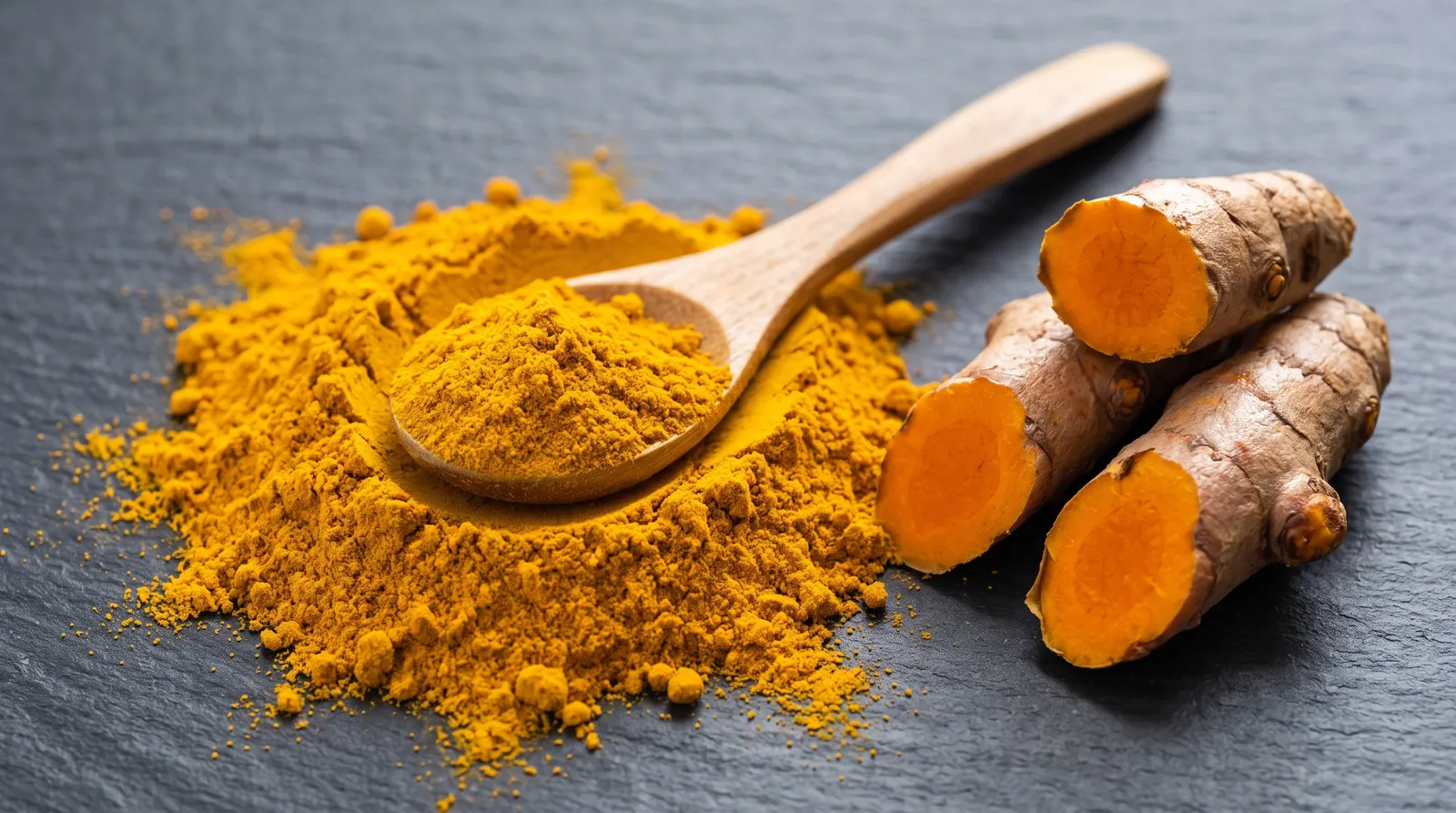
The dried, ground rhizome (an underground stem, not a root) of Curcuma longa, a plant in the ginger family. Fresh turmeric root looks similar to fresh ginger but stains orange-yellow on cutting; the dried, ground form sold as a spice is what almost every kitchen actually uses. The crop is dug after roughly eight or nine months in the ground, when the leaves yellow and die back. The rhizomes are cleaned, boiled or steamed to set the colour and firm the starch, then dried in the sun for weeks before milling. That curing step is why dried turmeric keeps for years in a sealed jar while fresh root spoils in weeks, and why the two do not substitute cleanly: the fresh root is resinous and more aromatic, and it carries water that a powder does not.
Taste profile
Warm, faintly bitter, slightly musky and earthy, with a mustard-like pungency in large quantities. It is not a heat spice — the color is far stronger than the flavor, which is why small amounts go into almost everything without dominating the dish. The aromatic part is volatile, so turmeric wants a little fat and a little heat to open up; stirred into a cold liquid it stays flat. A quarter to half a teaspoon suits a pot serving four, and past about a teaspoon the bitterness begins to show at the back of the mouth.
Forms to buy
- Ground — The form used in nearly all home and restaurant cooking.
- Fresh root — Grated raw into a few regional dishes; stains everything it touches.
- Whole dried fingers — Cured rhizomes ground at home; more aromatic, far more work, and hard on the grinder.
The science behind it
The yellow color of turmeric comes mainly from curcumin and its close relatives, a group called curcuminoids. Curcumin dissolves poorly in water but readily in fat and oil. That is the chemical reason turmeric is usually bloomed in hot oil or ghee at the start of cooking: the pigment spreads evenly through the fat and tints the whole dish instead of clumping in the liquid. The earthy, faintly bitter aroma comes from the volatile oil in the rhizome, a mix of smaller aromatic compounds that is much weaker than the color.
Curcumin is the most studied compound in turmeric, and it is also one of the least well absorbed. Laboratory studies report effects on inflammatory and antioxidant pathways, but these are mostly cell and animal findings and do not show what happens when people eat turmeric as food. Reviews attribute the poor bioavailability to low water solubility, limited uptake in the small intestine, and fast metabolism in the liver. In a dose-escalation study of 24 healthy volunteers, single doses of up to 12 grams were well tolerated, but curcumin was not detectable in blood at doses up to 8 grams and appeared only at low levels at 10 and 12 grams. A 2024 critical analysis of clinical trials found that reported gains in absorption came mainly from industry-sponsored studies and were not reproduced in independent ones, and it found no convincing evidence of benefit in cancer. Supplement formulations are far more concentrated than the curcumin in a pinch of turmeric in a curry, so the research does not show that cooking with turmeric treats or prevents any condition.
Sources: Dose escalation of a curcuminoid formulation, Lao et al., BMC Complementary and Alternative Medicine (2006); The Holy Grail of Curcumin and its Efficacy in Various Diseases: Is Bioavailability Truly a Big Concern? Journal of Restorative Medicine (2017); Dietary Curcumin: Correlation between Bioavailability and Health Potential, Nutrients (2019); Clinical trials on curcumin in relation to its bioavailability and effect on malignant diseases: critical analysis, Naunyn-Schmiedeberg's Archives of Pharmacology (2024)
This summarizes published research for general interest. Most studies use concentrated extracts at doses far above what a recipe contains, and none of it is medical advice — talk to a doctor before using any spice as a treatment.
In Vedic and ritual tradition
Turmeric is haridra in Sanskrit, the root of the Hindi name haldi. Haridra is named in the Atharvaveda, in the Kausika Sutra, the ritual manual attached to it, in the Charaka Samhita, and, for washing and healing wounds, in the Garuda Purana. Its ritual life is much more visible in later Hindu practice. In western and southern India, the Haldi Kumkum custom has married women exchange turmeric and red kumkum powder to wish each other's families long life, health and prosperity, a custom popular accounts trace to Maratha and Peshwa-era Maharashtra. Before a wedding, turmeric paste is often applied to the bride and groom, and the bride's marriage thread is commonly dyed with it. The name haridra is sometimes explained as dear to Hari, a name of Vishnu, though dictionary entries more often derive it from the yellow color.
- Atharvaveda — The Atharvaveda and its ritual manual, the Kausika Sutra, name haridra, but what those texts say about turmeric is not established.
- Charaka Samhita — Haridra is used throughout Ayurvedic literature such as the Charaka Samhita, with listed uses including skin disease, jaundice and cough; the specific passages are not identified.
- Garuda Purana (Ayurveda sections) — The Ayurveda sections of the Garuda Purana include wound-cleansing formulas that combine two kinds of haridra with other herbs.
- Manasollasa (12th century) — The 12th-century Manasollasa, a Sanskrit encyclopedia, mentions turmeric pulp used in a king's bath, an early example of its use on the body beyond medicine.
Sources: Wisdom Library, Haridra (turmeric) definitions and textual citations; Wisdom Library, Turmeric definition (Garuda Purana wound formulas); India Currents, Haldi: that wondrous golden rootstalk (wedding and Haldi Kumkum customs)
Halal note
The raw spice itself carries no halal concern. Pre-mixed turmeric-based seasoning blends occasionally include anti-caking or flavor-carrier additives worth checking on the label if strict avoidance of non-halal-certified additives matters to you.