Cardamom
Also known as: elaichi
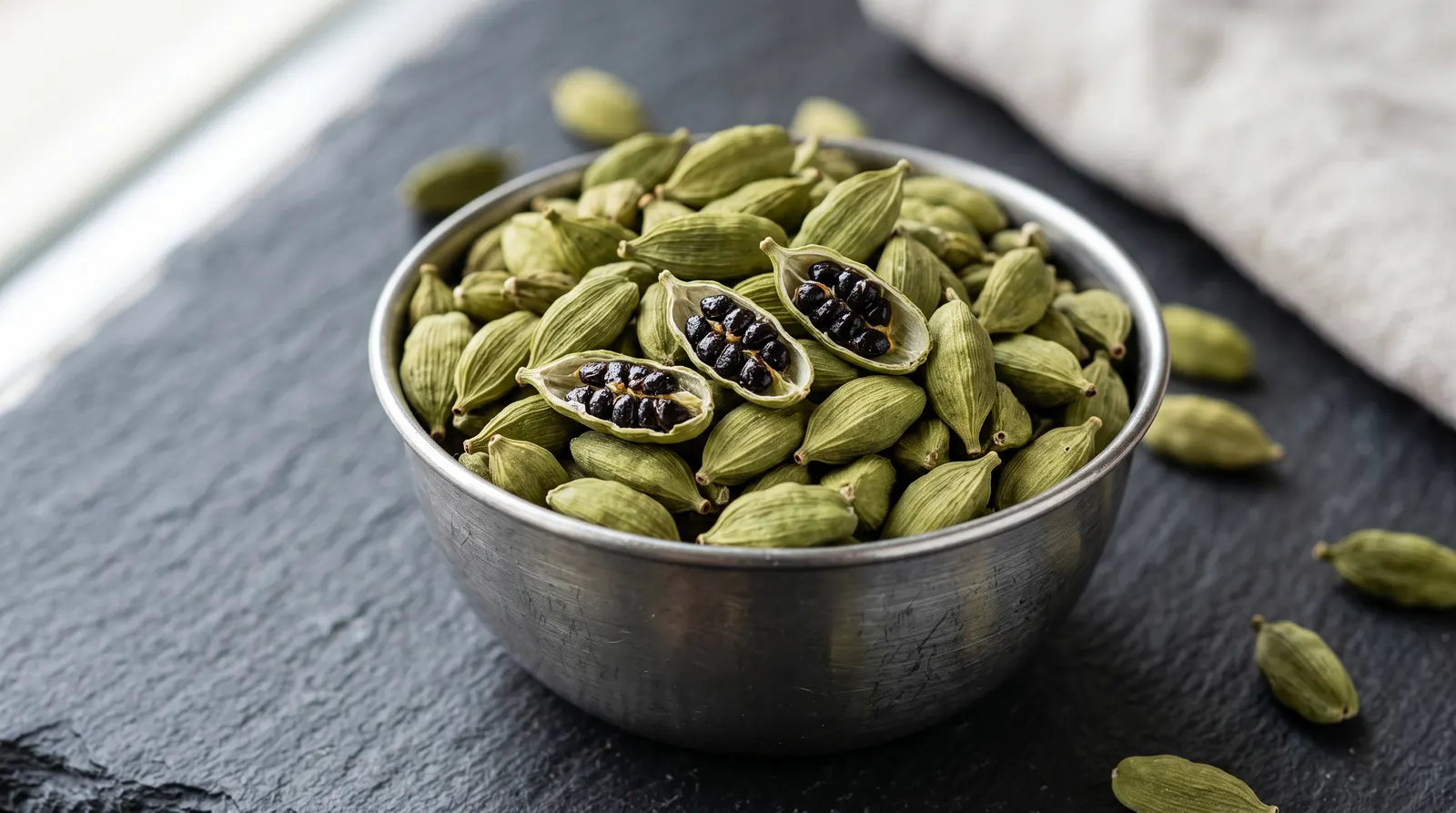
What Cardamom is
A small, intensely fragrant pod that scents both sweet and savory cooking — the spice most responsible for the smell of masala chai and biryani alike. Green and black cardamom are different pods used for entirely different purposes, not interchangeable substitutes.
The dried seed pod of plants in the ginger family, mainly Elettaria cardamomum for the small green pods and Amomum subulatum for the larger, smoke-dried black pods. Both are grown at altitude in the Western Ghats and the Himalayan foothills, where the plant needs shade and rain. The pods are picked by hand just before they would split, and that timing is most of the quality question: a pod left on the plant too long opens, and the seeds inside lose their oil to the air. Green pods are dried slowly at low heat, which is what keeps their colour bright. Black cardamom is dried over wood smoke, and that is where the smoke in its flavour comes from, rather than from the plant itself. A clump takes several years to bear and is picked over a season rather than all at once. Guatemala is now the world's largest producer of green cardamom, ahead of India, and the pale pods sold in some shops as white cardamom are bleached green ones with less aroma.
Taste profile
Green cardamom is intensely floral, sweet and slightly camphor-like, equally at home in tea, dessert and rice. Black cardamom is smoky, resinous and savory only — it belongs in a biryani or a meat curry, never in a sweet dish, since the smoke overwhelms sugar entirely. A whole green pod smells of very little until it is crushed or heated, because the oil is locked inside the seed; bruise it with the flat of a knife and the aroma arrives at once. Bloomed in ghee it turns sweet and almost citrus-like, which is why it goes in at the start of a biryani, while a pod dropped into liquid holds together longer and gives up less. Two or three pods scent a dish for four. Past half a dozen the camphor note takes over and the food tastes of medicine rather than of cardamom.
Forms to buy
- Whole green pods — Bruised or split before use so the aroma escapes into the dish.
- Whole black pods — For savory, slow-cooked meat dishes only.
- Ground — Loses aroma fastest of all whole spices; buy in small amounts.
- Hulled seeds — The inner seeds stripped of their papery husk, for blends where the husk would show.
The science behind it
Cardamom's aroma comes mainly from two compounds in the essential oil: 1,8-cineole and alpha-terpinyl acetate. A plant monograph in the PROSEA reference series gives 1,8-cineole at roughly 20 to 60 percent and alpha-terpinyl acetate at roughly 20 to 53 percent of the oil, and individual analyses of Indian oils differ widely, for example 38.8 and 24.6 percent in one and 24.7 and 49.0 percent in another. That mix gives green cardamom its cool, camphor-like, floral note.
Cardamom has been studied for effects on blood pressure, lipids, blood sugar and inflammation, mostly in animal and cell studies. A 2021 narrative review of cardamom and metabolic syndrome summarizes six small human trials, each using about 3 grams a day for 8 to 16 weeks in people with prediabetes, type 2 diabetes, fatty liver disease, polycystic ovary syndrome or stage 1 hypertension. Some trials reported lower triglycerides, cholesterol or blood pressure, while another found no significant change in blood pressure, which the authors suggest may reflect a short intervention and small sample. Cardamom is a food spice with preliminary and mixed human data, and the trials are too small and short to support any health recommendation.
Sources: Yahyazadeh et al., The effect of Elettaria cardamomum (cardamom) on the metabolic syndrome: narrative review, Iranian Journal of Basic Medical Sciences (2021); PROSEA monograph, Elettaria cardamomum, essential oil composition
This summarizes published research for general interest. Most studies use concentrated extracts at doses far above what a recipe contains, and none of it is medical advice — talk to a doctor before using any spice as a treatment.
In Vedic and ritual tradition
Cardamom is ela in Sanskrit, the source of the Hindi elaichi. The name is used across Ayurvedic literature, with the Charaka Samhita as one example, and dictionary entries record ela for the Sushruta Samhita as well. The 15th-century Yogasarasangraha identifies ela as Elettaria cardamomum, the 12th-century Manasollasa lists cardamom in unguents applied after massage and bathing, and the Kashyapa Samhita includes ela in a snake-poison antidote. These classical references show cardamom's place in medicine without detailing its use. Today cardamom is a fixture of Indian food and drink, especially in sweets and tea, and no specific ritual role for it is established. Outside South Asia it also flavours Arabic coffee and Scandinavian baking, a sign of how widely the spice travelled with trade.
- Charaka Samhita — Ela, or cardamom, is used throughout Ayurvedic literature, and the Charaka Samhita is one of the texts that use the name.
- Sushruta Samhita — Dictionary entries record ela as cardamom in the Sushruta Samhita, one of the classical sources for the name.
- Manasollasa (12th century) — This 12th-century Sanskrit encyclopedia lists cardamom among the ingredients of unguents applied after massage and bathing, a cosmetic and comfort use.
- Yogasarasangraha (15th century) — This 15th-century compendium of Ayurvedic recipes by Vasudeva identifies ela as Elettaria cardamomum, which fixes the botanical identity of the name.
Sources: Wisdom Library, Ela (cardamom) definitions and textual citations
Halal note
Cardamom pods and ground cardamom carry no halal concern. Cardamom-flavored syrups and some commercial extracts use alcohol as a carrier solvent, which is worth checking if you avoid alcohol-based flavorings specifically.