Cloves
Also known as: laung
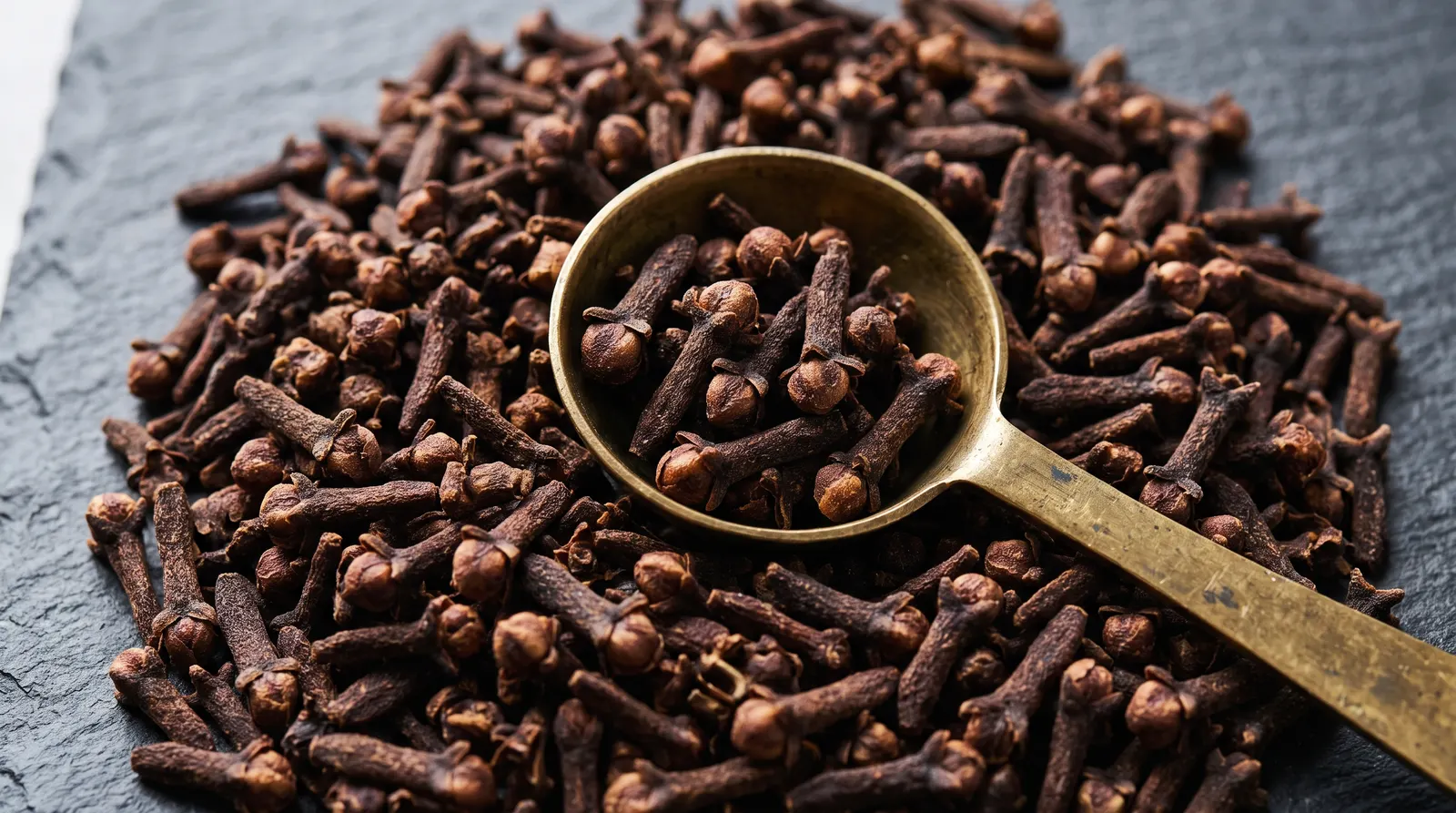
What Cloves is
A small, nail-shaped dried flower bud with an intensity out of proportion to its size — a handful is enough to flavor an entire pot of biryani or a full pan of chai. Used whole and removed before serving, or bitten into by accident, which numbs the tongue briefly.
The dried, unopened flower bud of Syzygium aromaticum, a tropical evergreen tree native to Indonesia and now grown widely in coastal India. The tree takes six or seven years to flower, so a smallholder planting it waits a long time for a first crop. The buds are taken at the moment they turn from green to a faint pink, before they open, because an open flower is worth nothing as a spice. They are then dried for several days until they shrivel into the nail shape sold in shops. Nearly all of the oil sits in the bud rather than the stem, which is why a broken bud smells so much stronger than the woody stalk below it. Indonesia is still the largest producer. A fresh bud leaves a faint trace of oil when pressed with a fingernail, while a dry, pale bud has lost most of it.
Taste profile
Intensely pungent, sweet and warmly medicinal, with a numbing effect on the tongue in any quantity — the same eugenol compound that gives clove oil its use as a dental analgesic. A few cloves carry through an entire dish; more than that turns bitter and overpowering. The whole bud gives up its oil slowly, which is why it survives a long braise and is fished out at the end rather than eaten. Fried in ghee it turns sweet and almost fruity for a few seconds before the medicinal edge takes over, and that window is narrow. Ground clove is far more aggressive than the whole bud: a quarter teaspoon in a dish for four is already a strong hand, and past that it swamps everything else in the pot.
Forms to buy
- Whole bud — The near-universal form; used sparingly and fished out before eating.
- Ground — Rare in savory cooking; mostly used in baking spice mixes.
- Clove stems — The woody stalk below the bud, much weaker and sold mainly for distillation rather than cooking.
The science behind it
Cloves get their intensity mainly from eugenol, a phenolic compound that makes up most of the clove oil and gives the spice its warm, sweet, medicinal smell. Other components include eugenyl acetate and beta-caryophyllene, which add to the spicy, woody notes. Eugenol is sensitive to oxidation, so whole cloves keep their aroma far longer than ground cloves.
Eugenol has been studied extensively in cells and animals, with reported antioxidant, antimicrobial, anti-inflammatory and analgesic activity. A 2021 review in the International Journal of Molecular Sciences describes these effects, much of it from laboratory work on bacteria, fungi and cell lines, and warns that high concentrations can be harmful: in one study, high clove oil concentrations increased DNA breaks in normal human fibroblast cells, and eugenol can cause allergic contact dermatitis, including in dental workers. The review cites a maximum allowable daily intake of 2.5 milligrams per kilogram of body weight from the FAO/WHO expert committee on food additives. A 2017 review adds a case report of a toddler who developed liver failure after swallowing clove oil and says studies of eugenol's cytotoxicity and genotoxicity are limited and conflicting. The dental use of clove oil concerns concentrated oil, not the whole bud in a dish.
Sources: Ulanowska and Olas, Biological Properties and Prospects for the Application of Eugenol, a review, International Journal of Molecular Sciences (2021); Mohammadi Nejad, Ozgunes and Basaran, Pharmacological and toxicological properties of eugenol, Turkish Journal of Pharmaceutical Sciences (2017)
This summarizes published research for general interest. Most studies use concentrated extracts at doses far above what a recipe contains, and none of it is medical advice — talk to a doctor before using any spice as a treatment.
In Vedic and ritual tradition
Clove is lavanga in Sanskrit, and medieval Sanskrit writing treats it as a medicine, a perfume ingredient, a ritual food and a literary image. The 7th-century Madhavacikitsa, chapter 2, uses lavanga for atisara, or diarrhea, and the 17th-century Bhojanakutuhala lists it among fruits for aggravated phlegm and as a remedy for indigestion. It appears in aromatic and cosmetic formulas, including unguents in the 12th-century Manasollasa and perfumery materials in the 16th-century Gandhavada. In religious practice, the 10th-century Saurapurana names lavanga as the food taken in the month of Jyeshtha for the Anangatrayodashi vrata, a religious observance. The Shivapurana mentions the clove creeper in a poetic image, a literary reference rather than a ritual use. The trade history is as long as the culinary one: clove grew on a handful of islands in the Moluccas and nowhere else for most of its recorded history, and was carried to Zanzibar and Madagascar only in the nineteenth century, long after it had become a fixture of European cooking.
- Bhojanakutuhala (17th century) — A Sanskrit treatise on food by Raghunatha, written in Maharashtra, that sets out how dishes are prepared alongside the medical properties of each ingredient.
- Madhavacikitsa (chapter 2, 7th century) — Chapter 2 of this 7th-century text uses lavanga in treating atisara, or diarrhea.
- Saurapurana (10th century) — One of the upapuranas, the secondary Puranas. Its Jyeshtha vrata passage is one of the few ritual, rather than medical or literary, references to clove in these sources.
Sources: Wisdom Library, Lavanga (clove) definitions and textual citations
Halal note
Cloves and clove powder carry no halal concern. Clove cigarettes and some clove-scented personal-care products are unrelated consumer goods and have no bearing on the culinary spice.