Cinnamon
Also known as: dalchini
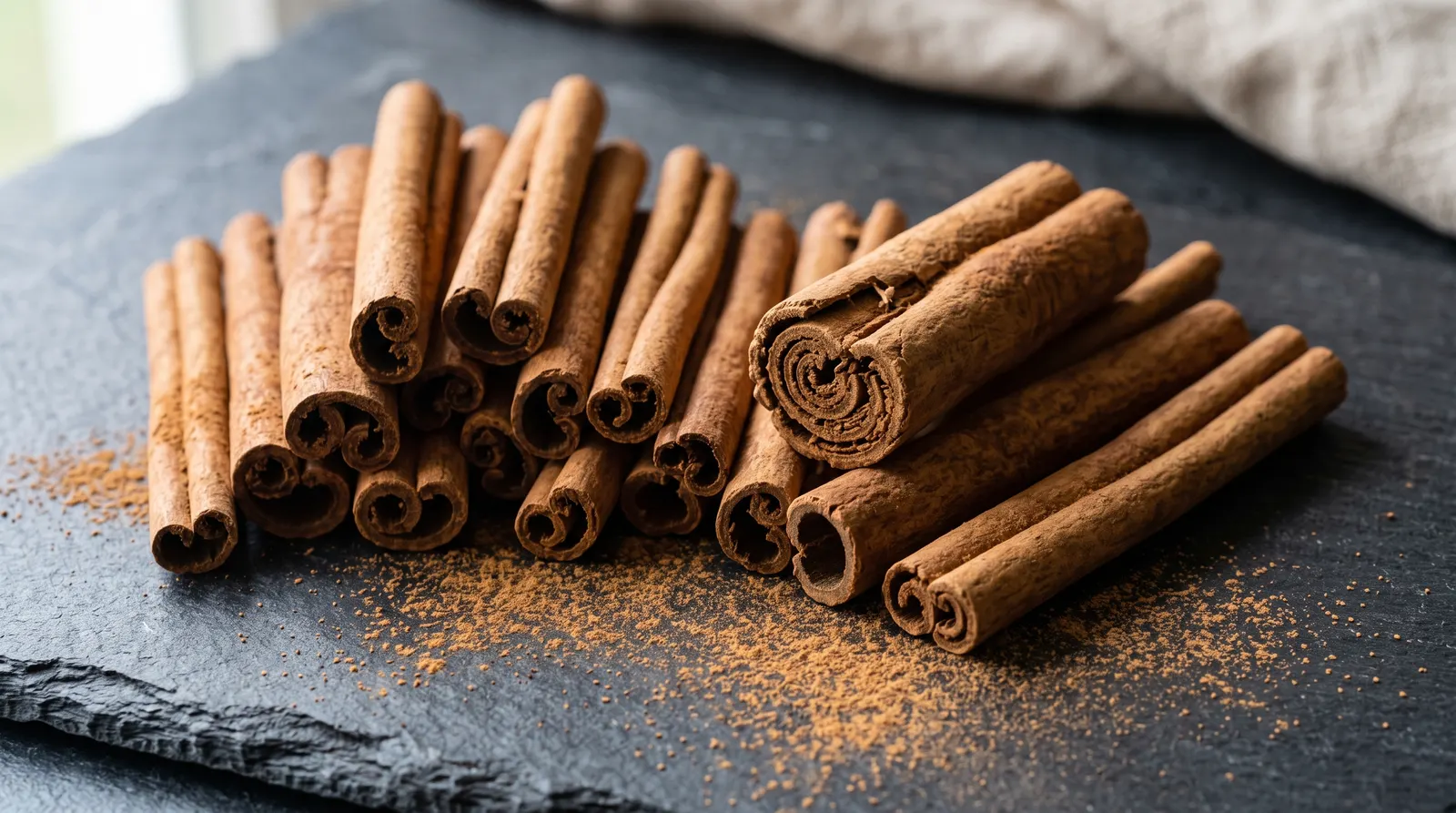
What Cinnamon is
A warm, sweet whole spice bloomed in hot fat at the start of a biryani or curry, or boiled directly into masala chai. Most cinnamon sold in South Asian and Western shops is actually a related bark called cassia, not the more delicate 'true' cinnamon of Sri Lanka.
The dried inner bark of a tree in the laurel family, harvested in curled quills. What most recipes and spice boxes simply call cinnamon is usually Cinnamomum cassia, thicker-barked and stronger-flavored than Cinnamomum verum, the softer 'true' Ceylon cinnamon sold separately. The bark comes from trees cut back to stumps and allowed to send up straight shoots, which are harvested on a cycle of a year or two. The outer bark is scraped off, the inner bark lifted in long strips, and the strips curl as they dry, which is what gives a stick its shape. True Ceylon cinnamon is built from many thin layers rolled into one another and is pale and papery; cassia is a single thick layer that dries into a hard, reddish-brown curl.
Taste profile
Warm, sweet and woody, with a faint peppery heat underneath. Cassia, the common form, is bolder and slightly more astringent than true cinnamon, which is why a single stick can carry flavor through an entire pot of biryani or a full pan of simmering chai. A whole stick is quiet until it is heated: snapped into hot ghee it unfurls within seconds and turns sweet and woody, and left in the pan it scorches at the edges and the sweetness sours. Simmered in milk or tea it gives up its aroma slowly over ten or fifteen minutes, which is why chai is boiled rather than steeped. Ground cinnamon is a different proposition, since the powder releases everything at once and burns easily in hot fat. A two-inch stick or a quarter teaspoon of powder is enough for a pot for four; more leaves an astringent, drying sensation on the tongue.
Forms to buy
- Whole stick — Bloomed in hot fat or simmered whole; removed before serving.
- Ground — For baking and spice blends; too strong in ground form for most savory pots.
- Cassia bark pieces — Thick broken bark, the strongest and cheapest form, for slow dishes where it will be fished out.
The science behind it
Cinnamon's flavor and smell come mainly from cinnamaldehyde, the compound that gives the bark its sweet, warm, spicy character. In cassia, the cinnamon most often sold in South Asian shops, cinnamaldehyde is the dominant component of the bark oil, though the share varies by sample: one review reports 75 to 90 percent, while a 2013 analysis cited in another review found about 42 percent. Cassia also contains coumarin, which is present in very small amounts in true Ceylon cinnamon.
Cinnamon has been studied for effects on blood sugar, particularly in people with type 2 diabetes, but the evidence is not settled. In a 2006 assessment, Germany's Federal Institute for Risk Assessment (BfR) concluded that the claimed blood sugar effect had not been sufficiently proven, and that no reliable data existed on safety for daily long-term intake in the gram range. The main safety question is coumarin in cassia. The BfR notes that the European Food Safety Authority set a tolerable daily intake of 0.1 milligram of coumarin per kilogram of body weight, which cinnamon capsules taken at recommended doses can exceed, while Ceylon cinnamon contains hardly any. The BfR also raised cinnamaldehyde as a possible concern in pregnancy, based on animal data, in concentrated capsule products. A pinch of cinnamon in food is a flavoring and not a treatment, and the research on higher doses is limited and inconsistent.
Sources: BfR Health Assessment No. 044/2006, High daily intakes of cinnamon: health risk cannot be ruled out (coumarin and cinnamaldehyde); Cinnamomum cassia Presl: a review of its traditional uses, phytochemistry, pharmacology and toxicology, Molecules (2019); Zaidi et al., Diverse pharmacological properties of Cinnamomum cassia: a review, Pakistan Journal of Pharmaceutical Sciences (2015)
This summarizes published research for general interest. Most studies use concentrated extracts at doses far above what a recipe contains, and none of it is medical advice — talk to a doctor before using any spice as a treatment.
In Vedic and ritual tradition
Cinnamon is tvak in Sanskrit, a word the Ayurvedic and medieval materia medica use for the bark. The 7th-century Madhavacikitsa, chapter 2, lists preparations using tvak for atisara, or diarrhea. The word has several possible botanical identities, including Cinnamomum verum, the true cinnamon, as well as cassia and Indian bay. Tvak also means skin in Sanskrit, so context matters when reading the sources. Cinnamon has a more visible record in the Western tradition: Exodus 30 gives a recipe for the holy anointing oil, in which 250 shekels of sweet cinnamon are blended with 500 shekels of myrrh and other ingredients, for use on the tabernacle and its furnishings. English translations render the Hebrew term as sweet or fragrant cinnamon. No specific South Asian ceremonial role for cinnamon is established.
- Madhavacikitsa (chapter 2, 7th century) — This 7th-century text lists tvak among the preparations for atisara, or diarrhea. The same chapter also covers cumin, coriander and clove for diarrhea.
- Book of Exodus (30:22-25) — The recipe for the holy anointing oil gives sweet cinnamon at 250 shekels, half the 500 shekels of myrrh, in the King James translation of verse 23.
Sources: Wisdom Library, Tvak (cinnamon) definitions; King James Bible, Exodus 30:23
Halal note
Cinnamon bark and cinnamon powder carry no halal concern. Cinnamon-flavored extracts and some essential-oil-based flavorings use alcohol as a carrier, a point worth checking only in those concentrated products, not the whole or ground spice.