Coriander Seed
Also known as: dhania
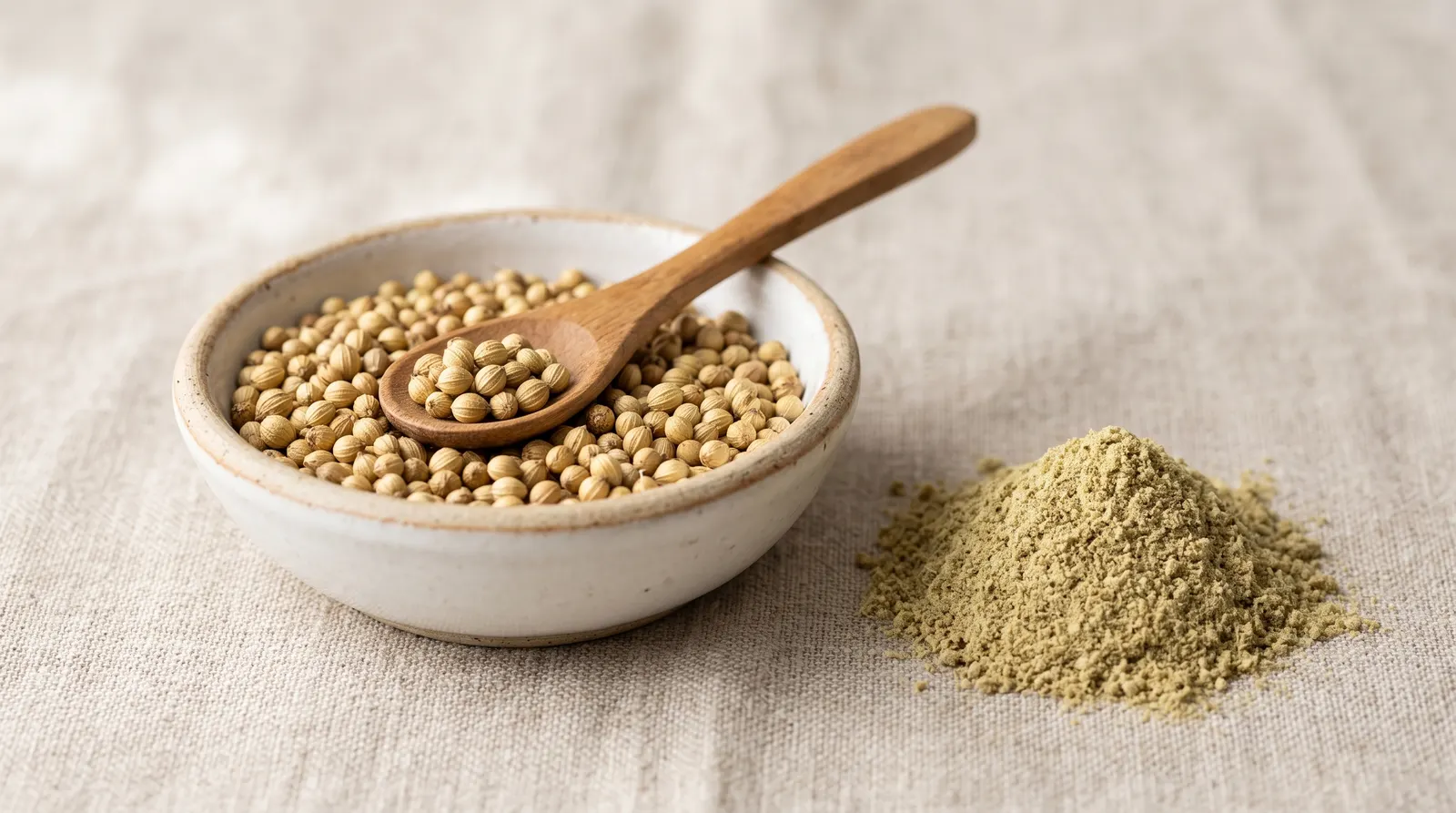
What Coriander Seed is
The dried seed of the same plant whose fresh leaves are called coriander or cilantro, but tasting nothing like the leaf. Ground coriander seed, alongside cumin, is the base note of most North and South Asian gravies, added for body rather than to be noticed on its own.
The small, round, ridged dried fruit of Coriandrum sativum. The same plant grown for its leaf is left to flower and seed for this spice, which is harvested, dried and sold whole or ground into the powder most recipes call simply 'coriander powder' or dhania. The whole plant is cut once the stems yellow, laid out to dry, and then threshed; the round fruits are in fact pairs of seeds that split apart in the process, which is why a jar of coriander seed rattles rather than rolls. Drying turns them from green to a pale, even brown, and the colour of the powder depends on how much husk survives the mill. Green, unripe coriander seed is also used fresh in some regional pickles, where it tastes nothing like the dried form. Small-fruited types, common in India, carry more oil than the larger-fruited types grown in Europe and North Africa. Stored whole in a sealed jar the seed stays usable for a year or two, while the ground powder fades within a few months.
Taste profile
Sweet, citrusy and faintly floral, with a warm, nutty background. It is much milder and rounder than cumin, and its job in a gravy is to thicken and mellow rather than to stand out as a distinct flavor. The whole seed is fairly quiet until it is heated: toasted dry in a pan for a minute or two it darkens several shades and the citrus note sharpens towards orange peel, and that step is what separates a good coriander powder from a flat one. A tablespoon of the ground spice to a curry for four is ordinary. It is one of the few spices that can be overdone without turning harsh — the failure is a soapy, perfumed thickness rather than bitterness.
Forms to buy
- Whole seed — Toasted and ground fresh for the best aroma; also used whole in pickles.
- Ground — The everyday form, sold as coriander powder or dhania powder.
- Cracked — Roughly crushed for pickles and some northern breads, where the pieces should still be visible.
- Dhania-jeera powder — Ground coriander and cumin mixed together and sold ready-made as a base for everyday gravies.
The science behind it
Coriander seed's flavor comes mainly from its essential oil, which is dominated by linalool, a floral, citrus-like monoterpene alcohol. The oil also contains smaller amounts of compounds such as alpha-pinene, gamma-terpinene and geranyl acetate. Linalool is a reason the seed tastes sweet and citrusy and not sharp or grassy like the fresh leaf. Its share of the oil varies by origin: in a 2024 study of nine Iranian and Iraqi populations, linalool ranged from about 64 to 74 percent of the seed oil.
Coriander seed and its main compound linalool have been studied for a wide range of reported effects, including effects on blood sugar, cholesterol, anxiety, pain and inflammation. A 2022 review in the Journal of Food Science cites many of these findings from rats, mice and cell lines, and it describes the evidence on linalool for anxiety, seizures and pain as coming from animal and cell studies, with no human linalool trials described. Human data on coriander are sparse: the review reports one trial in 50 volunteers taking coriander fruit powder capsules twice daily for six weeks, with lower plasma glucose and blood lipids, but gives few design details. The authors call for more toxicity studies at higher doses and over longer periods. The seed is regarded as safe as a seasoning, with itching or stinging of the mouth reported and, rarely, severe allergic reactions. A spoonful of ground seed spread across a dish for four is a very different dose from the capsules used in trials, and this research does not show that cooking with coriander treats or prevents any condition.
Sources: Sobhani et al., Ethnobotanical and phytochemical aspects of the edible herb Coriandrum sativum L., Journal of Food Science (2022); Talebi et al., Chemical composition and antimicrobial activity of essential oils in coriander populations from Iran and Iraq, Food Science & Nutrition (2024)
This summarizes published research for general interest. Most studies use concentrated extracts at doses far above what a recipe contains, and none of it is medical advice — talk to a doctor before using any spice as a treatment.
In Vedic and ritual tradition
Coriander seed is dhanyaka in Sanskrit, with related names such as dhanya, dhanika and dhaneya. The 13th-century Rajanighantu, in verses 6.35-37, identifies dhanyaka with coriander, calls it sweet, cooling, astringent and calming to pitta, and gives fifteen synonyms for the plant. The 7th-century Madhavacikitsa uses dhanyaka as another name for kustumburu in a treatment for fever, and includes it in chapter 2 among preparations for diarrhea. These are medieval sources. Coriander seed is one of the most ordinary ingredients in Indian cooking, so it appears in food more than in ritual, and no Vedic text or ceremonial use for the seed is named.
- Madhavacikitsa (7th century) — The 7th-century Madhavacikitsa gives dhanyaka as another name for kustumburu in a fever treatment, and its chapter 2 includes it among preparations for diarrhea (atisara).
- Rajanighantu (13th century) — Verses 6.35-37 of this 13th-century text identify dhanyaka with coriander, call it sweet, cooling and astringent, and give fifteen synonyms, including dhaneya and dhanika.
Sources: Wisdom Library, Dhanyaka (coriander) definitions and citations
Halal note
Coriander seed carries no halal concern in any form. The one point worth knowing is that 'coriander' can mean either this dried seed or the fresh leaf — they are not interchangeable in a recipe.