Bay Leaf
Also known as: tej patta
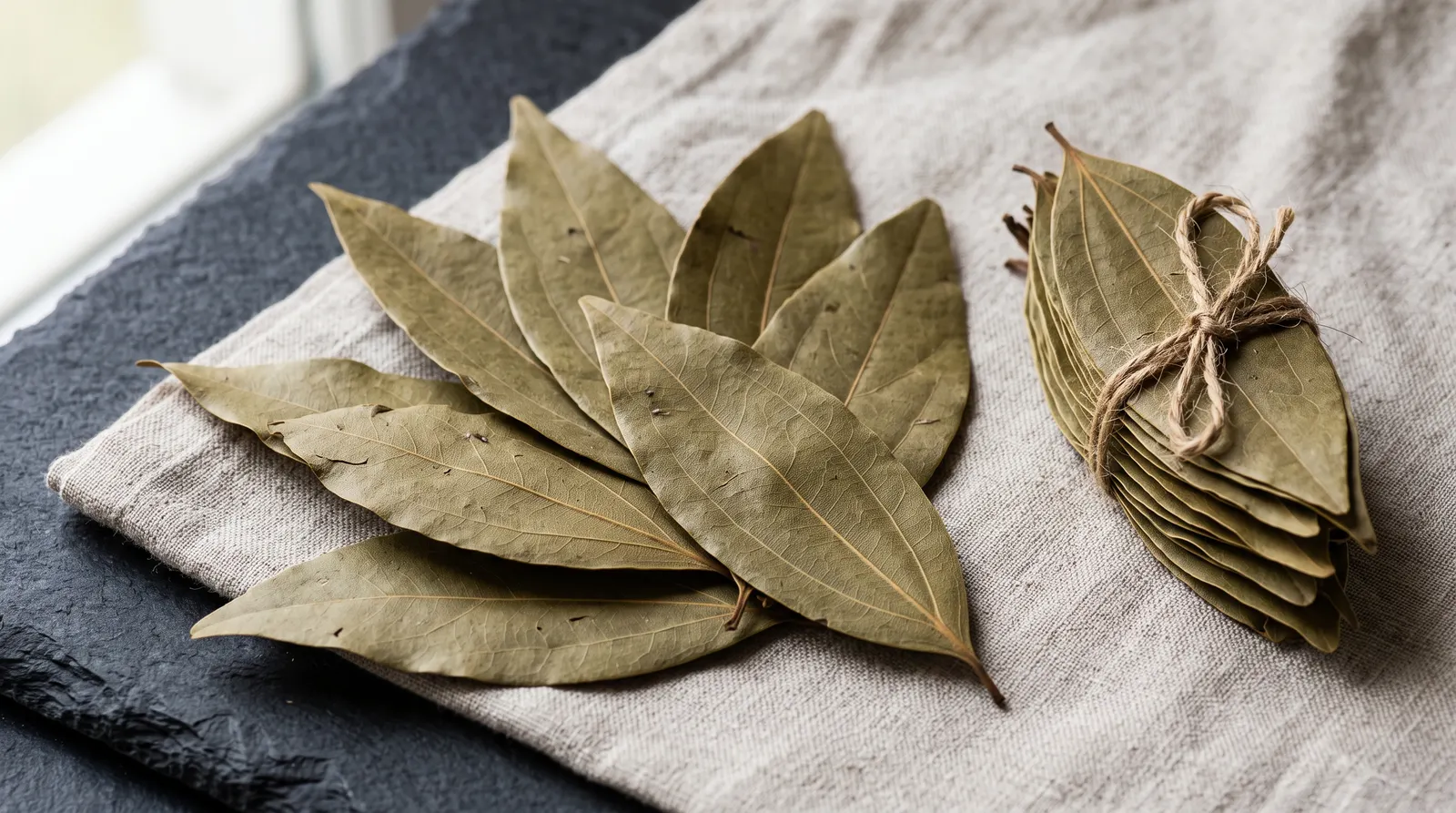
What Bay Leaf is
A large, dried aromatic leaf dropped whole into biryani and slow-cooked curries as they start, then left in the pot for the whole cook. The Indian bay leaf sold for this purpose is a different plant from the Mediterranean bay leaf used in Western cooking.
Most bay leaf sold in South Asian grocery shops as tej patta comes from Cinnamomum tamala, a relative of cinnamon, not from Laurus nobilis, the Mediterranean laurel bay leaf found in Western supermarkets. The two look similar dried but come from different trees, and the easiest way to tell them apart is the veins: Mediterranean bay has one central vein with smaller veins branching off it. Packets may be labelled Indian bay leaf, Indian cassia leaf or cassia leaf. The tree is a medium evergreen with thick, leathery, strongly three-veined leaves: one vein runs from base to tip and two curve up from near the bottom. Leaves are taken by cutting whole leafy twigs, which is why packets in Indian shops often contain leaves still attached to a thin woody stem. They are dried in the shade rather than in direct sun, which keeps them olive-brown instead of bleached, and a leaf dried too fast goes brittle and loses the aroma that makes it worth using. A good dried tej patta is roughly the length of a hand. The tree grows in the Himalayan foothills of Nepal and north-east India, where much of the supply comes from.
Taste profile
Tej patta carries a warm, cinnamon-and-clove-like aroma with almost none of the sharp, menthol-like bitterness of Mediterranean bay leaf. It is added whole at the start of cooking and is never meant to be eaten or ground into a dish. The leaf does not soften into the food: it stays leathery through an hour of simmering, and its perfume comes out slowly. Crushed between the fingers, a good leaf smells of cinnamon and clove with a resinous edge, and that smell fades with age; a leaf that has sat in the cupboard for two years gives almost no scent. One leaf is right for a pot serving four. In pulao and biryani it goes into the oil with the other whole spices before the rice, so the fat carries its scent through every grain. Mediterranean bay can stand in if nothing else is available, but it gives a sharper, more eucalyptus-like note without the cinnamon warmth. Two begins to read as medicinal, and a leaf left in long enough to break down turns the dish bitter in a way no amount of cream covers.
Forms to buy
- Whole dried leaf — The only common form; always removed before serving.
- Ground (tej patta powder) — Sold for blends and some restaurant kitchens; it loses the slow release and the easy removal.
- Fresh leaves — Occasionally sold in season; softer, greener and harsher than the dried leaf.
The science behind it
Indian bay leaf is known in Sanskrit as tamalapatra. The composition of the leaf's essential oil varies by origin. A 2018 study of leaves from Uttarakhand found linalool at about 37 percent, cinnamaldehyde at about 31 percent and limonene at about 7 percent, and a 2022 study from the Kathmandu Valley in Nepal also found linalool and cinnamaldehyde as the main components. Because oil content and makeup change with origin, drying and processing, one packet of leaves may smell different from another.
Cinnamomum tamala has been studied in the laboratory for antioxidant and antimicrobial effects. A 2018 study found that the essential oil from Uttarakhand leaves was effective in the laboratory against Staphylococcus aureus, Bacillus cereus and Candida albicans. A 2022 Nepalese study reported that an ethyl acetate extract showed high antioxidant activity in a DPPH test, and that the oil and a chloroform extract were active against Candida albicans in the laboratory. These results come from oils and extracts tested in vitro, with different methods and solvents, so they are not directly comparable. Neither study tested people, and the research does not show that eating a leaf in a biryani does anything measurable to the body at that dose.
Sources: Tyagi, Antimicrobial activity and chemical profiling of Cinnamomum tamala essential oil from Uttarakhand region of India, Journal of Pharmacognosy and Phytochemistry (2018); Tandukar et al., GC-MS profiling and bioactivities of essential oil and extracts of Cinnamomum tamala leaves from Kathmandu Valley, Nepal, Amrit Research Journal (2022)
This summarizes published research for general interest. Most studies use concentrated extracts at doses far above what a recipe contains, and none of it is medical advice — talk to a doctor before using any spice as a treatment.
In Vedic and ritual tradition
Bay leaf in South Asian cooking is tejpatra or tamalapatra in Sanskrit. Tejpatra is identified with Cinnamomum tamala, also known as Laurus tamala, though other identifications are possible, including Cinnamomum iners and Cinnamomum wightii. The name tamalapatra is used across Ayurvedic literature, with the Charaka Samhita among the texts that use it, and a Sanskrit dictionary cites a tamala leaf from classical literature, which shows the plant's long familiarity in Sanskrit writing, though the source of that quotation is unclear. The leaf's recorded role is mainly as a flavoring and perfume in cooking, and no specific ceremonial use is established.
- Charaka Samhita — The name tamalapatra appears throughout Ayurvedic literature, and the Charaka Samhita is one of the texts that use it.
Sources: Wisdom Library, Tamalapatra definitions; Wisdom Library, Tejapatra definitions and Cinnamomum tamala identification
Halal note
Bay leaf carries no halal concern in any form; it is a plain dried leaf with no processing beyond drying.