Ginger-Garlic
Also known as: adrak-lehsun paste
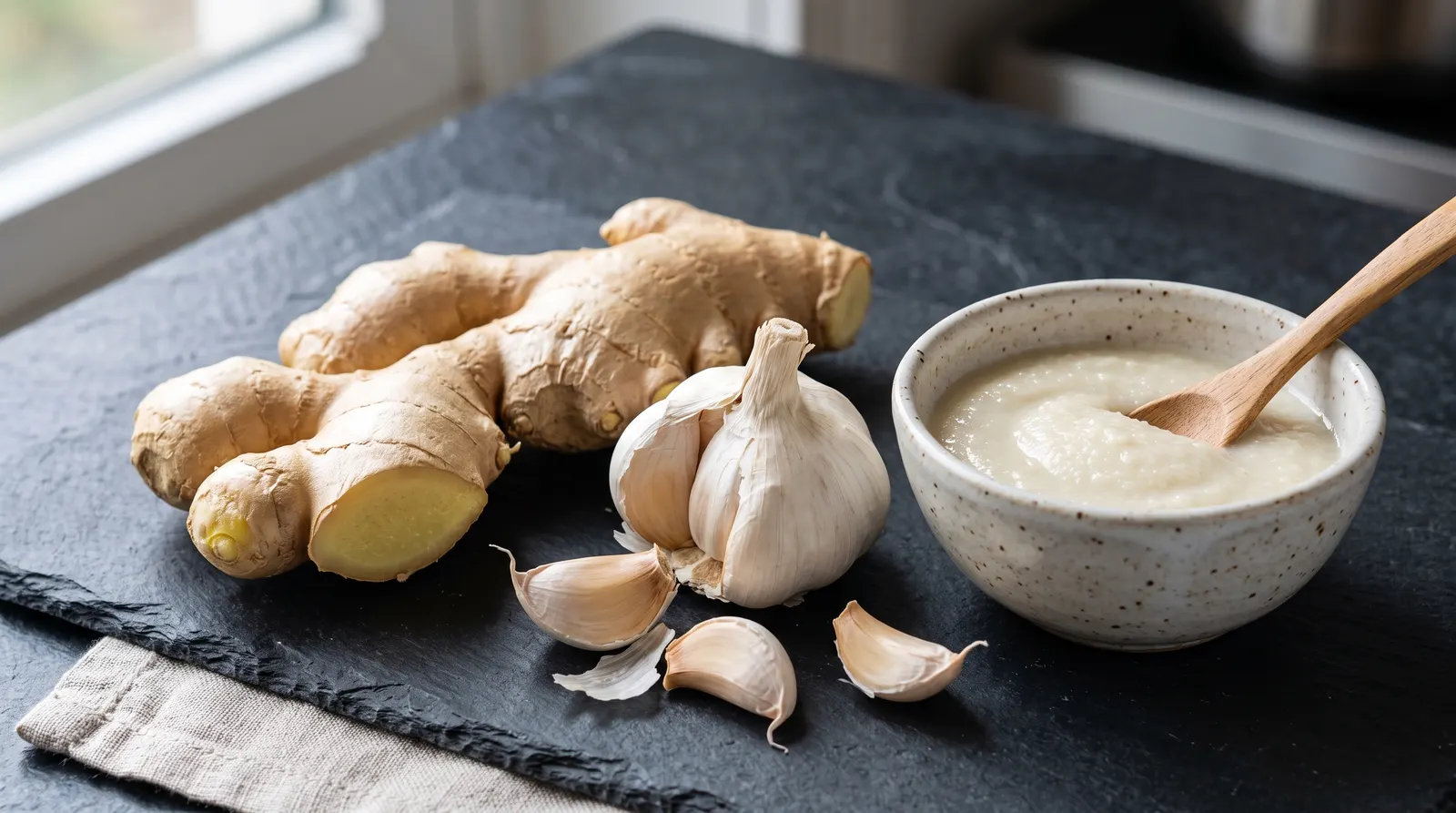
What Ginger-Garlic is
Not a single botanical spice but a fresh paste of roughly equal parts ginger and garlic, blended together and used as the flavor base of the overwhelming majority of South Asian savory cooking, added early and cooked out before the rest of the masala is built.
A blended paste of fresh ginger, the rhizome of Zingiber officinale, and fresh garlic, the bulb of Allium sativum, usually pounded or blitzed together with a little water or oil. Making it fresh from the two whole ingredients gives a noticeably brighter result than a jarred paste.
Taste profile
Sharp, pungent and almost unpleasantly raw straight from the blender — the 'raw smell' that recipes explicitly cook out is real and detectable. Once fried in hot fat for a couple of minutes it mellows into a rounded, sweet, savory depth that underlies the whole finished dish.
Forms to buy
- Fresh, made at home — Pounded or blended just before cooking; the strongest flavor.
- Ready-made jarred paste — A common shortcut, kept in the fridge for weeks.
- Whole ginger and garlic — Bought separately and prepared as each recipe calls for.
The science behind it
Ginger's bite comes mainly from gingerols in the fresh rhizome. Gingerols are heat-sensitive: on drying or long cooking they lose water and convert to shogaols, which are more pungent, so dried ginger often tastes hotter than fresh. Garlic works differently. Its odorless sulfur compound alliin sits in intact cells, and when a clove is crushed or chopped the enzyme alliinase acts on it and allicin forms, a reactive compound responsible for the raw, sharp smell. Allicin is unstable and breaks down quickly into other sulfur compounds such as diallyl disulfide, so garlic cooked in fat tastes sweet and nutty rather than harsh. That is the reason the paste is cooked out in oil before tomatoes and spices go in: the raw sulfur sharpness mellows and the sugars in the garlic brown.
Most research on ginger and garlic is laboratory or animal work on isolated compounds, and it does not tell us what a spoonful of paste does in a person. A review of 6-shogaol notes that conclusive clinical data are largely lacking and that most anti-inflammatory evidence comes from cell and animal studies. Ginger's best-studied human use is nausea in pregnancy. A 2014 systematic review of 12 randomized trials found that ginger reduced nausea more than placebo, but the authors described the evidence as low quality: most trials had a high risk of bias, doses and preparations varied, and the effect on vomiting was not statistically significant. For garlic, a 2023 meta-analysis of randomized trials of garlic supplements, not cooked food, found lower diastolic blood pressure, triglycerides, total cholesterol and LDL cholesterol, but no significant change in systolic pressure or HDL, with high heterogeneity between trials and moderate to low certainty of evidence. None of this shows that the paste treats or prevents any condition, and culinary amounts are far below the doses used in these trials.
Sources: Benefits of Ginger and Its Constituent 6-Shogaol in Inhibiting Inflammatory Processes, Pharmaceuticals (2021); Allicin: Chemistry and Biological Properties, Molecules (2014); A systematic review and meta-analysis of the effect and safety of ginger in the treatment of pregnancy-associated nausea and vomiting, Nutrition Journal (2014); Effects of garlic supplementation on components of metabolic syndrome: a systematic review, meta-analysis, and meta-regression of randomized controlled trials, BMC Complementary Medicine and Therapies (2023)
This summarizes published research for general interest. Most studies use concentrated extracts at doses far above what a recipe contains, and none of it is medical advice — talk to a doctor before using any spice as a treatment.
In Vedic and ritual tradition
Ginger has a long Ayurvedic record under two names: ardraka for the fresh rhizome and shunthi for the dried one, and classical pharmacology treats them as related but distinct drugs. An online index of the Charaka Samhita lists shunthi under synonyms that include Vishwa-bheshajam and Mahaushadha, names that translate roughly as the universal medicine and the great medicine, and records dozens of references to it across the text. Garlic, lashuna, has a separate and more contested place. The Bower Manuscript, a Sanskrit medical manuscript on birch bark found near Kucha in Central Asia and generally dated to about the 5th or 6th century CE, opens with a treatise on garlic, framed as a conversation among sages, covering its medicinal properties, recipes and use for eye diseases. Some Hindu communities, notably Vaishnava devotees, and some Jain communities avoid garlic and onion, and devotional teachers commonly link this to the idea that alliums are rajasic or tamasic and are unfit for offerings or disturb meditation. That is a belief about purity and temperament, not a documented medical finding, and practice varies widely. In kitchens that leave out alliums, ginger carries much of the aromatic work.
- Charaka Samhita — An online index of the Charaka Samhita (not a translation) lists shunthi under synonyms including Vishwa-bheshajam and Mahaushadha, and its uses are indexed across the Sutrasthana, Vimanasthana and Chikitsasthana, from digestive and colic remedies to gruels, decoctions and medicated ghee preparations. The dating of the Samhita itself is debated.
- Bower Manuscript (garlic treatise) — The Bower Manuscript, a birch-bark Sanskrit medical text found near Kucha and generally dated to the late 5th or early 6th century CE, opens with a fragment on garlic (lashuna) in about 43 verses. The separate Navanitaka, a compendium of powders, ghees and oils, is another part of the same manuscript.
Sources: Charaka Samhita Online: Shunthi; Bower Manuscript (Wikipedia); Why no Garlic and Onions? (devotional account, ISKCON Desire Tree)
Halal note
Fresh ginger and garlic carry no halal concern. Jarred ready-made pastes commonly include vinegar or citric acid as a preservative, both halal, though it is still worth checking the label on any pre-made version for added stabilizers of unclear origin.