Garam Masala
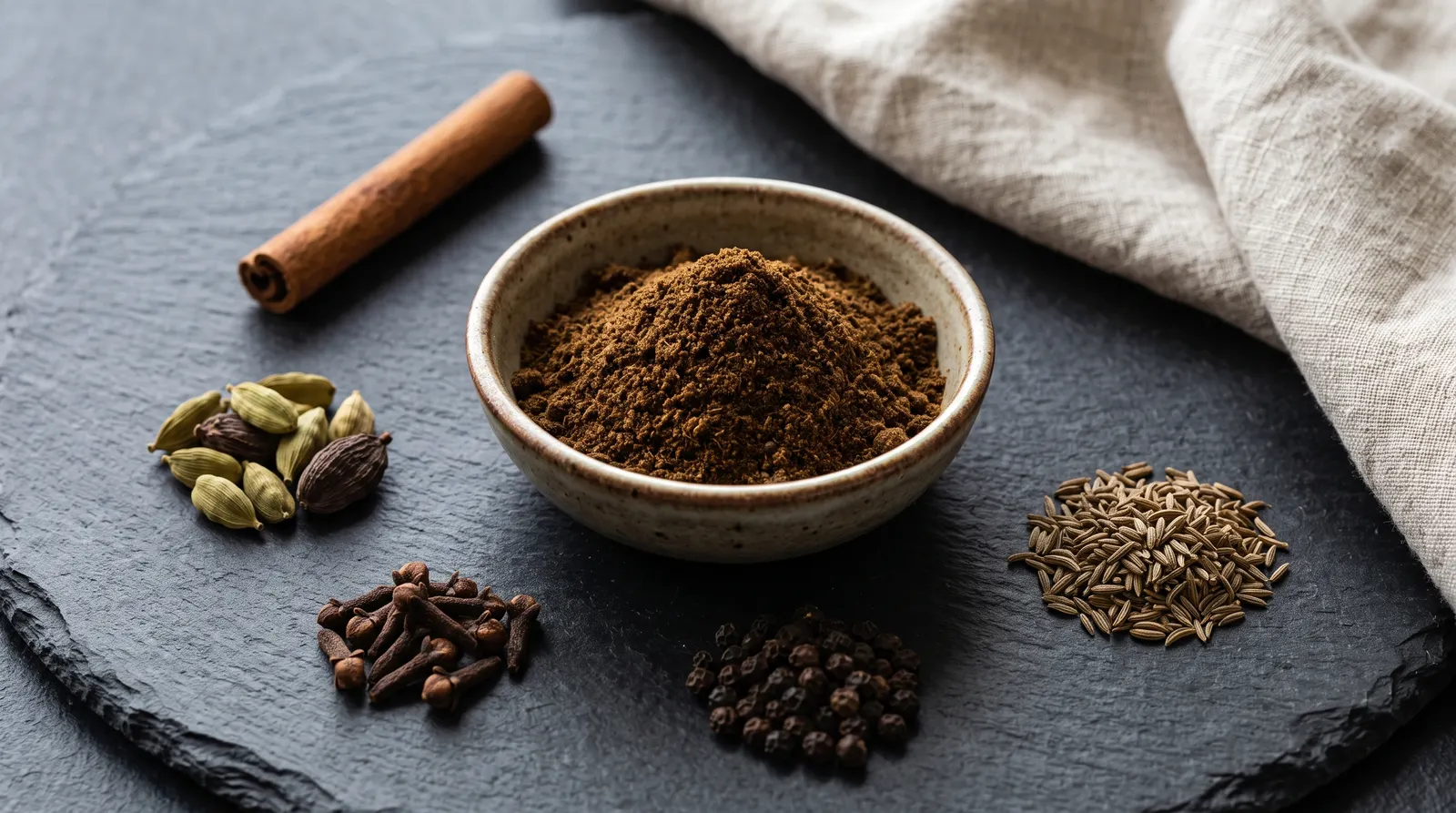
What Garam Masala is
Not a single spice but a roasted, ground blend of warm spices, stirred in near the end of cooking rather than the start so its aroma survives to the plate. Composition varies by household and region, but the family of spices it draws from is consistent.
A ground mixture typically built from cinnamon, cardamom, cloves, cumin, coriander seed, black pepper and bay leaf, dry-roasted together and ground fine. Some blends add nutmeg, mace or star anise; there is no single fixed recipe, only a family resemblance across kitchens. It is made by toasting the whole spices dry until they smell warm, lifting them off the heat before they darken, then grinding and cooling them in a sealed jar. Toasting them together is a compromise, since cumin and coriander brown faster than cinnamon and clove, so a careful cook toasts the seeds first and adds the bark and buds for the last few seconds. Proportions are the whole craft: a blend heavy on cinnamon is sweet and suits rich meat, while one heavy on cumin and pepper is drier and sharper. Commercial blends are ground finer and lean on coriander and cumin, which is part of why they taste flatter than a small home batch.
Taste profile
Warm, sweet-savory and deeply fragrant rather than hot — garam masala carries almost none of a dish's chilli heat, which comes from separate chilli powder. Its job is aroma: added at the very end of cooking so its more delicate, volatile notes are not boiled away. Because it is already ground and already toasted, it does not need cooking. Stirred into a hot pot with the heat off, or sprinkled over a dish just before serving, it keeps its top notes; boiled for twenty minutes it goes dull and faintly bitter. A brief turn in ghee at the end, just long enough to smell it, is the one exception, and it takes seconds. A teaspoon finishes a dish for four. More than that and clove and cinnamon take over, giving a sweet, slightly soapy edge that reads as too much spice rather than as depth.
Forms to buy
- Ground blend — Sold pre-mixed; the form nearly everyone actually cooks with.
- Whole-spice mix — Roasted and ground fresh at home for a noticeably brighter aroma.
- Coarse grind — Left gritty on purpose for finishing, so the spices show on the surface of the dish.
The science behind it
Garam masala has no single chemistry of its own; its aroma is the sum of its component spices. Typical contributors are cinnamaldehyde from cinnamon, eugenol from clove, cuminaldehyde from cumin, linalool from coriander and cardamom's 1,8-cineole and alpha-terpinyl acetate, with piperine from black pepper adding a sharp note. Many blends are dry-roasted before grinding, and heat changes the aroma: in one cumin study, dry roasting and oil cooking both increased the strength of the seed's aroma. Each spice has its own volatile profile, so the blend's aroma varies with the proportions and the freshness of each ingredient.
No study found tested garam masala as a blend, so there is no direct evidence for any effect of the mixture. The evidence that exists is for its components, and it is mostly preliminary. For cinnamon, Germany's BfR judged in 2006 that a claimed blood sugar effect was not sufficiently proven and raised a coumarin concern with cassia at high doses. For cardamom, a 2021 review found only small and mixed human trials. For clove, the eugenol literature is mostly laboratory and animal work, with toxicity warnings at high concentrations. Adding these findings together is not valid, because the doses, forms and interactions in a spice blend differ from those in isolated studies.
Sources: BfR Health Assessment No. 044/2006, High daily intakes of cinnamon: health risk cannot be ruled out; Ulanowska and Olas, Biological Properties and Prospects for the Application of Eugenol, International Journal of Molecular Sciences (2021); Yahyazadeh et al., The effect of Elettaria cardamomum on the metabolic syndrome: narrative review, Iranian Journal of Basic Medical Sciences (2021)
This summarizes published research for general interest. Most studies use concentrated extracts at doses far above what a recipe contains, and none of it is medical advice — talk to a doctor before using any spice as a treatment.
In Vedic and ritual tradition
Garam masala is a blend of ground spices used across the Indian subcontinent, and its name is usually translated as hot or warm spices. Recipes vary by region and household, and versions differ in details such as cassia in place of cinnamon, black cardamom alongside green, or chilli. The blend itself is not described in the classical Sanskrit medical texts, which describe the individual spices, such as clove, with their own uses. Its role is culinary. No ritual use of garam masala as a mixture is established. The mixture is a convenience in one sense and an old idea in another: cooks have always combined warm spices for a particular dish, and garam masala simply fixes one combination so the same handful can be used across many.
- Bhojanakutuhala (17th century) — The 17th-century Bhojanakutuhala lists clove among remedies for indigestion and aggravated phlegm. It treats clove as a single spice, not as part of a blend.
- Madhavacikitsa (chapter 2, 7th century) — The 7th-century Madhavacikitsa, chapter 2, uses cinnamon and clove in preparations for diarrhea, two component spices of the blend. The blend itself is not described there.
Sources: Wikipedia, Garam masala (name, typical ingredients and regional variation); Wisdom Library, Lavanga (clove) definitions and textual citations; Wisdom Library, Tvak (cinnamon) definitions
Halal note
The individual spices in garam masala carry no halal concern. Some commercial pre-ground blends include anti-caking agents or are milled on shared equipment with other spice products, worth a label check for anyone avoiding cross-contact strictly.