Fennel Seed
Also known as: saunf
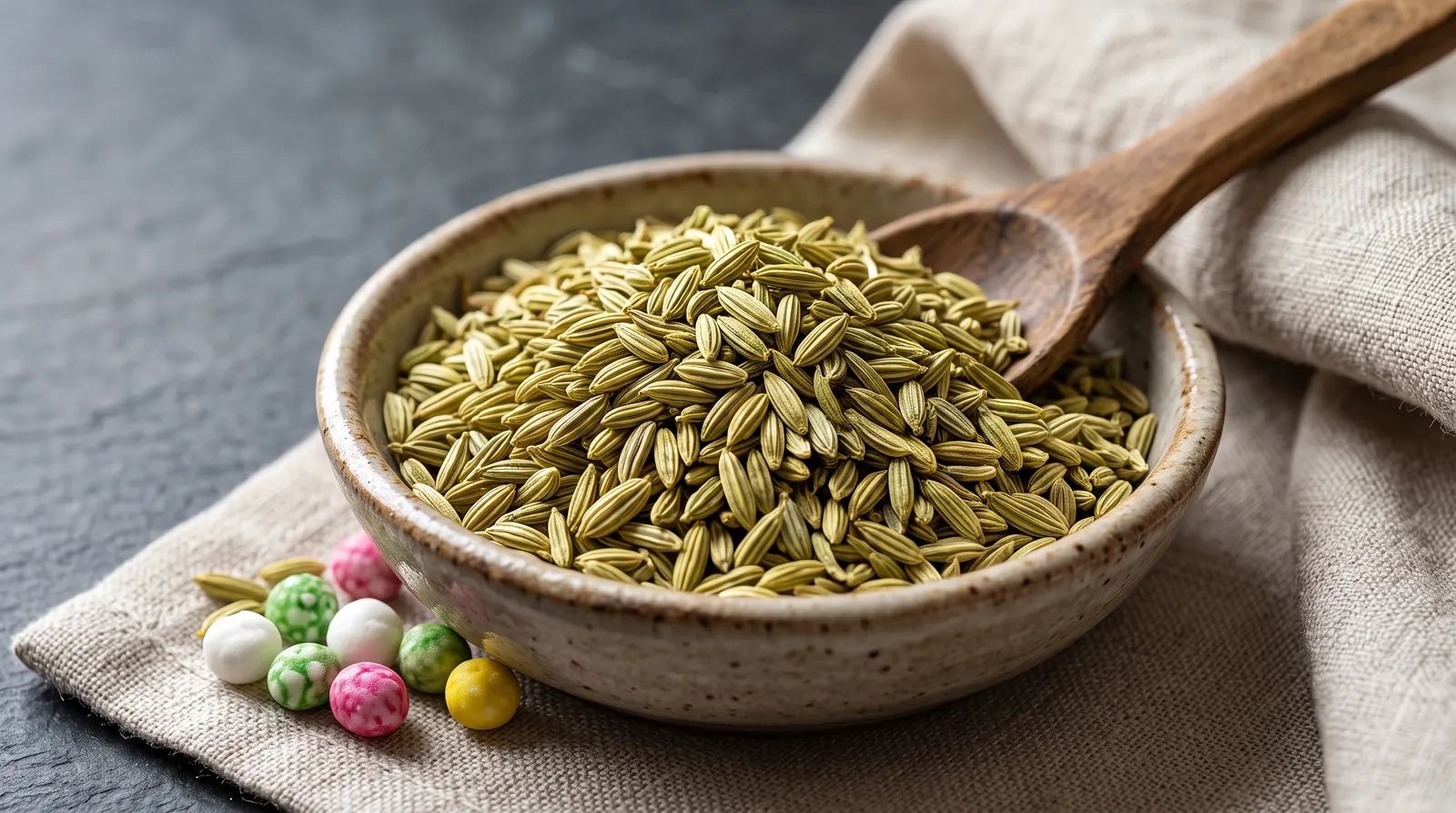
What Fennel Seed is
The sweetest seed in the South Asian spice box, and the one with a whole life outside the pot: the spoonful of roasted or sugar-coated fennel offered after a meal, chewed as a digestif under the name mukhwas and a fixture of Indian restaurant counters. In cooking it does the opposite job from cumin — where cumin deepens a savory base, fennel lifts and sweetens it — and in Kashmiri Pandit cuisine it is a signature spice, ground in generous quantities into gravies built without onion or garlic.
The small, ridged, green-brown dried fruit of Foeniculum vulgare, a plant in the carrot family alongside cumin, dill and caraway; like cumin it is botanically a schizocarp but sold everywhere as a seed. India grows most of the world's crop, and Indian grocers in Japan sell it in small packets for a few hundred yen. Color is the freshness cue: green seed, harvested early and dried carefully, is brighter and sweeter, while the pale brown seed in cheap packets is older stock with less aroma left in it. It is also one of the five seeds in Bengali panch phoron and a frequent component of masala chai blends, where its sweetness rounds out the cardamom and ginger.
Taste profile
Sweet, cool and anise-like, from a compound called anethole that it shares with star anise and aniseed — the reason fennel reads as 'licorice' to palates that grew up without it. The finish is minty and faintly camphor-cool rather than hot. Toasted lightly the sweetness deepens; simmered in quantity, as in Kashmiri gravies, it turns warmly sweet and takes the heaviness off slow-cooked meat. A teaspoon in a pot is meant to be noticed. A teaspoon steeped a few minutes in hot water also makes a household fennel tea.
Forms to buy
- Whole seed — For chai blends, panch phoron, pickles and the after-meal bowl; holds its aroma whole for a long time.
- Ground — For Kashmiri-style gravies; grind in small amounts, it fades much faster than the whole seed.
- Mukhwas mixes — Candy-coated or roasted blends sold by the till; a confection, not a cooking spice.
The science behind it
Fennel's sweetness and anise aroma come mainly from trans-anethole, the compound that gives anise and star anise their licorice note. In a study of commercial fennel fruits from several countries, trans-anethole made up about 35 to 82 percent of the oil, fenchone 1.6 to 22.8 percent, estragole 2.4 to 17 percent and limonene 0.8 to 16.5 percent, so the profile varies a lot by variety and origin, with sweet types richest in anethole and bitter types richer in fenchone. Fenchone adds a camphor-like bitterness and limonene a citrusy top note. The seed has little sugar, so its sweet impression is mainly an aroma effect.
The most cited clinical use is infant colic, and the evidence is weak. A 2016 systematic review of interventions for breastfed infants pooled three fennel studies and estimated about 72 minutes less crying per day, but noted limitations. A 2019 meta-analysis of herbal products for colic found reduced crying time in four trials of fennel-containing preparations, though the abstract contains reporting inconsistencies and many products combined fennel with other herbs. A 2019 overview of systematic reviews called fennel the most promising herbal remedy for colic but rated most of the reviews as having critically low confidence or high risk of bias, noting that much of the fennel oil evidence comes from one trial with blinding and randomization concerns. These trials used infant preparations, not culinary seed. Fennel is also studied in the laboratory for antimicrobial and antioxidant effects, mostly with oils or extracts far above culinary concentrations. None of these studies tests fennel seed in an ordinary meal, and the after-dinner habit of chewing saunf is a cultural custom, not something shown to improve digestion.
Sources: Essential oil composition of Foeniculum vulgare Mill. fruits from pharmacies in different countries, Natural Product Research (2012); An overview of systematic reviews of complementary and alternative therapies for infantile colic, Systematic Reviews (2019); Effectiveness of Herbal Medicines Containing Phytoestrogens to Treat Infantile Colic: A Meta-analysis Review, Journal of Pediatrics Review (2019); Infant colic: what works, a systematic review of interventions for breastfed infants (Griffith University repository)
This summarizes published research for general interest. Most studies use concentrated extracts at doses far above what a recipe contains, and none of it is medical advice — talk to a doctor before using any spice as a treatment.
In Vedic and ritual tradition
Fennel's Sanskrit names are mishreya and shatapushpa, and the botanical identification is not settled. The 13th-century Raj Nighantu gives mishreya as possibly Foeniculum vulgare, with synonyms that include madhurika, meaning sweet one, and describes it as sweet, unctuous and pungent and as soothing kapha, pitta and vata. Other sources link the same name to dill or anise, and an online index of the Charaka Samhita identifies shatapushpa as Anethum sowa, a dill, while also glossing it as fennel, so the Sanskrit names may point to different plants depending on the text. Fennel's wider place in South Asian life is social rather than scriptural: a roasted seed offered after a meal, known as saunf, is a near-universal habit in Indian dining. Fennel has no documented ritual role in scripture.
- Raj Nighantu (13th century) — Verses 4.14 to 19 of this 13th-century text list mishreya as possibly Foeniculum vulgare, describe the plant as tentatively identified, and give about fourteen synonyms, including madhurika and supushpa. The text credits the plant with use in splenomegaly and as an anthelmintic.
- Charaka Samhita (shatapushpa) — The Charaka Samhita refers to shatapushpa about 25 times, for example in the Sutrasthana chapter 4 drug groups for medicated enemas and in a medicated ghee in the Chikitsasthana. The botanical identity of shatapushpa in the text remains open between dill and fennel.
Sources: Mishreya: definitions in Wisdom Library; Charaka Samhita Online: Shatapushpa
Halal note
Plain fennel seed carries no halal concern in any form. Compounded mukhwas mixes are the one place to glance at a label, since some use binders or colorings — neither of which applies to plain seed sold for cooking.