Chilli
Also known as: mirchi
What Chilli is
The source of heat in South Asian cooking, used fresh, dried whole or ground, and — despite how central it now feels to the cuisine — a genuinely recent arrival, brought to the region by Portuguese traders in the sixteenth century rather than grown there for millennia.
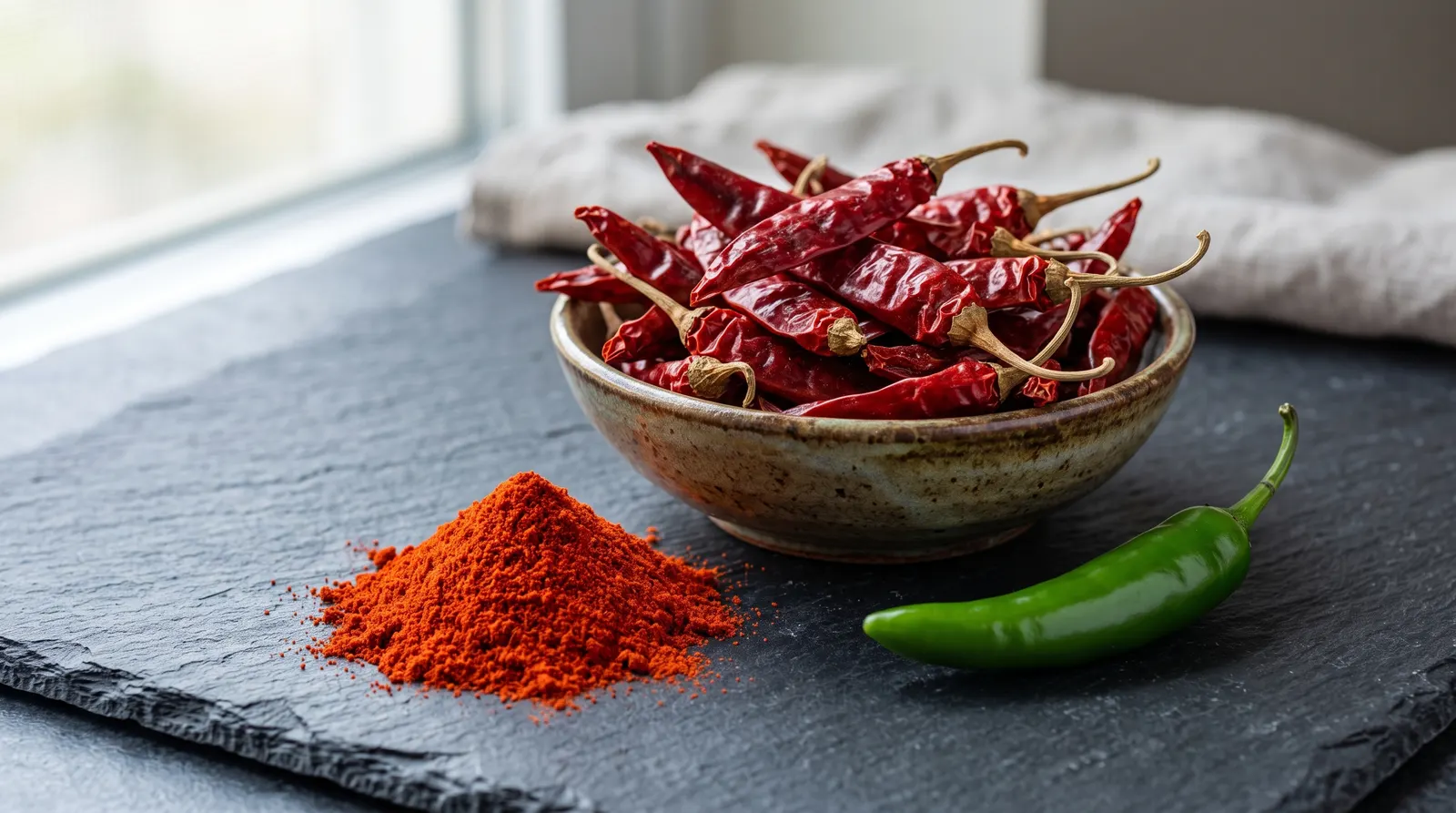
The fruit of Capsicum annuum and related species, native to the Americas and unknown in Asia before European contact. It spread quickly after its arrival because it grew easily in the same soil and climate as the black pepper it partly replaced as an affordable source of heat. Most of the heat sits in the pale pith along the inner walls, where the capsaicin is produced, rather than in the seeds, though the seeds are usually coated with it. Fresh green chillies are the unripe fruit; the same fruit left to redden and dry gives the whole dried chilli and, once ground, the powder. A thin-skinned chilli dries faster and more evenly than a thick one, which is one reason the small bird's-eye types dry as well as they do.
Taste profile
Heat varies enormously by variety, from the mild, mostly-for-color Kashmiri chilli to intensely hot bird's-eye types. Fresh green chilli brings a sharp, grassy heat; dried red chilli is deeper, smokier and slower to build, since drying concentrates both flavor and heat. Frying is what changes it most. Whole dried chillies dropped into hot oil for ten or fifteen seconds darken and take on a toasted, almost nutty note, while twenty seconds more blackens them and the whole pan tastes of soot, which is why they go in last in a tempering and come out at once. Powder behaves differently: stirred into hot fat it catches within seconds, so it is normally added off the heat or with a splash of liquid. Heat also builds in the food as it sits, so a curry that tastes fierce on the first day is often hotter on the second.
Forms to buy
- Fresh green — Sharp, immediate heat; often slit or chopped rather than powdered.
- Dried whole red — Fried in hot oil for a smoky, slow-building heat.
- Ground powder — Kashmiri chilli powder for color with mild heat; other blends for heat itself.
- Chilli flakes — Coarse crushed dried chilli, used more at the table than in the pot.
- Whole Kashmiri dried — Large, wrinkled and mild; soaked and ground for colour in restaurant gravies.
The science behind it
Chilli heat comes from capsaicin and related capsaicinoids, which bind the TRPV1 channel in the mouth and skin, the same channel that senses heat, so the body reads the compound as burning. Capsaicin is nonpolar, so it dissolves far better in fat and oil than in water. That is why a dish tempered in oil builds heat slowly and why water is a poor way to cool a mouth that has been burned. The color of chilli powder comes from separate carotenoid pigments, which is why Kashmiri chilli gives strong color with mild heat.
Capsaicin has been studied for pain, inflammation and metabolism, and a 2016 review in Molecules describes both its promise and its limits. The review notes capsaicin is a strong skin irritant even at low concentrations. In clinical studies of topical capsaicin, at least 30 percent of patients stopped treatment because of poor tolerability, and low-concentration products appear ineffective for chronic neuropathic and musculoskeletal pain. The reported anti-obesity effect was absent in mice lacking TRPV1, showing it depends on that receptor, while other proposed effects, such as on cancer cells, are described as not fully understood and are mostly from cell and animal work. The review also notes that epidemiologic reports link hot chili consumption to some cancers, which needs more study. In a small tasting panel of 12 untrained people, milk and ice cream were rated the best relievers of chilli heat, a sensory finding and not a health one. Chilli heat is well understood at the receptor level, while its health effects remain largely preclinical.
Sources: Basith et al., Harnessing the Therapeutic Potential of Capsaicin and Its Analogues in Pain and Other Diseases, Molecules (2016); The Effectiveness of Different Palate Relievers against a Hot Chili Pepper Sauce, Journal of Emerging Investigators (2016), a small student sensory study
This summarizes published research for general interest. Most studies use concentrated extracts at doses far above what a recipe contains, and none of it is medical advice — talk to a doctor before using any spice as a treatment.
In Vedic and ritual tradition
Chilli has no Vedic or classical Ayurvedic presence. It reached South Asia only in the 16th century, when Portuguese traders carried it to their colonies and trading posts in Asia, including Goa. The classical Sanskrit medical texts were composed centuries before that, so they could not name it. A useful sign of how recent it is comes from the Ain-i-Akbari, a Persian work written between 1589 and 1596. Its chapter of recipes for the imperial kitchen names pepper, cinnamon, cardamom, cloves, cumin, coriander seed, saffron and ginger, but no chilli, capsicum or red pepper. The text names pepper without giving its color or variety, so it cannot show for certain that no dish used chilli. Chilli then spread through local trade, and it became central to many regional cuisines only in later centuries.
- Ain-i-Akbari (Abu'l Fazl, 1589-1596), chapter of recipes for dishes — A Persian work from Akbar's Mughal court, covering the imperial kitchen. Its recipe chapter names no chilli, which suggests chilli was not yet a standard court ingredient at that time.
Sources: Wikipedia, Chili pepper (history and introduction to Asia, citing Collingham's Curry); Abu'l Fazl, Ain-i-Akbari, Book 1, Chapter 24, Recipes for Dishes, trans. H. Blochmann, hosted by Frances Pritchett, Columbia University; Wikipedia, Ain-i-Akbari (author, dates and contents)
Halal note
Chilli in every form carries no halal concern. Pre-made chilli sauces and pastes occasionally include vinegar or fish-derived flavor bases in some cuisines, though this is uncommon in South Asian chilli powders and pastes specifically.