Black Pepper
Also known as: kali mirch, marich
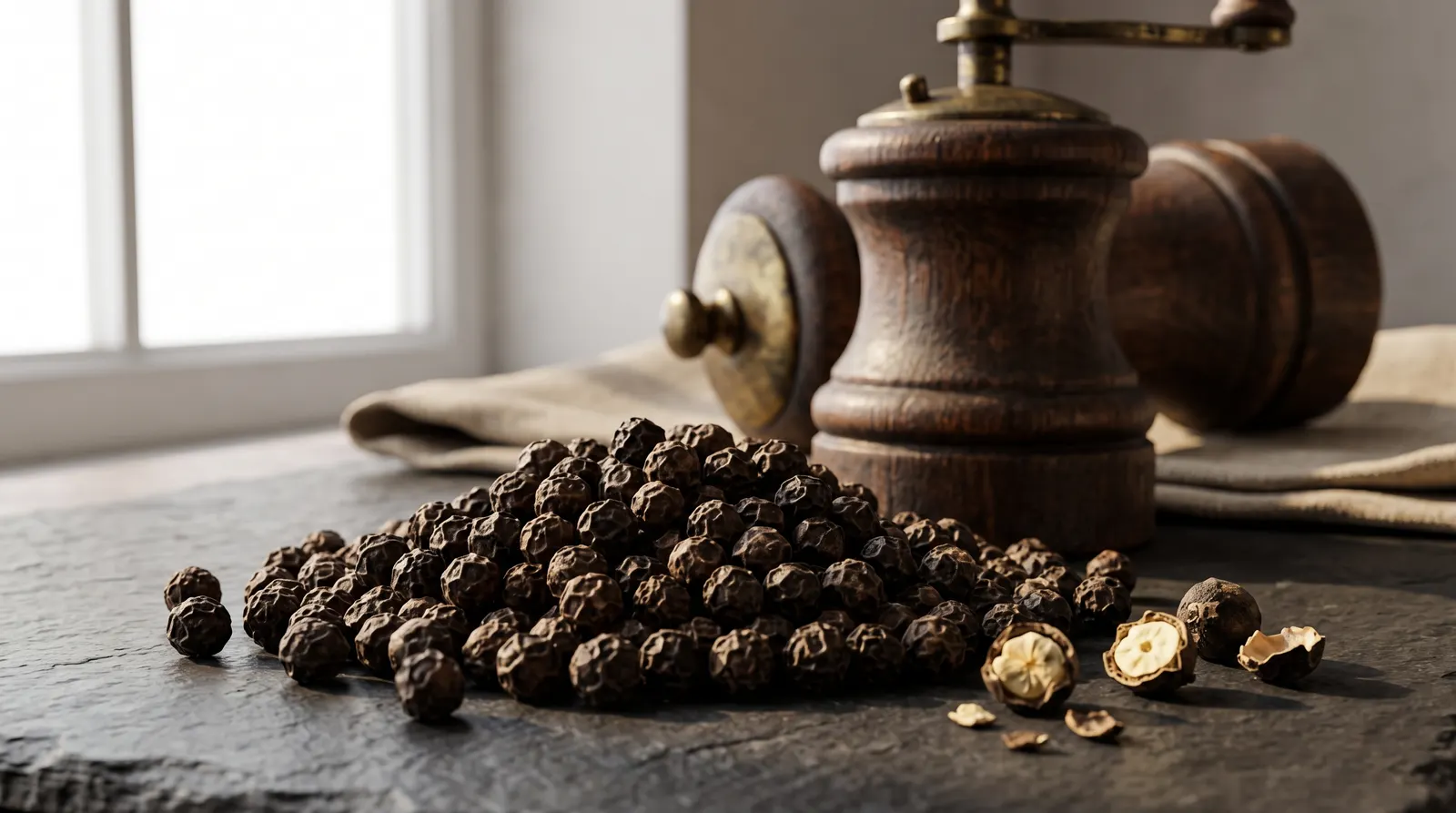
What Black Pepper is
The original heat spice of South Asian cooking, grown on India's Malabar Coast for well over two thousand years and the exact cargo Vasco da Gama was hunting when he landed in Kerala in 1498. Chilli, arriving from the Americas later that century, took over most of the everyday heat, but pepper never left the spice box: it is a fixed component of garam masala, a standard in curry powders, and the dominant spice in yogurt-based tandoori marinades, where its bite cuts through rich dairy fat.
The dried, unripe berry of Piper nigrum, a climbing vine native to the Malabar Coast of Kerala, picked while still green and sun-dried until it shrivels and blackens. White pepper is the same berry left to ripen, then soaked and skinned; green peppercorns are the same berry picked young and preserved. Indian grocers stock two main grades: Malabar, the standard berry, and Tellicherry — the colonial name for the port town of Thalassery — which grades out larger because the berries ripen longer on the vine. The English word 'pepper' itself descends, through Greek and Latin, from pippali, the Sanskrit name for its cousin long pepper, which Roman traders valued even more highly before black pepper won out. Vietnam now grows the largest share of the world's pepper, but the Malabar and Tellicherry names still mark the Indian grades.
Taste profile
The bite comes from piperine, which hits the front of the tongue and fades fast — a quicker, cleaner heat than chilli's capsaicin, which builds and lingers. Behind the bite the aroma is woody, faintly pine-like and citrusy, carried in volatile oils that evaporate within months of grinding; whole peppercorns hold them for years, which is why recipes that specify freshly ground pepper mean it. Piperine also raises how much curcumin the body absorbs from turmeric, one reason the two spices so often share a masala.
Forms to buy
- Whole peppercorns — Tellicherry grade for size and aroma; ground fresh per dish in a mill or mortar, never months ahead.
- Coarsely cracked — For marinades and crusts, where visible flakes of pepper are part of the point.
- White pepper — Milder and skinless; used where black specks would show in pale, cream-based gravies.
The science behind it
Black pepper's heat comes mainly from piperine, an alkaloid concentrated in the fruit's outer layer, together with related pungent amides. The aroma comes from the volatile oil, which is rich in terpenes such as pinene and limonene that evaporate fast. Piperine is hydrophobic and dissolves in fat, so pepper tends to show more in rich, oily or yogurt-based dishes. Adding pepper late keeps the volatile oils in play, while long cooking mostly flattens them.
Piperine is well studied in the laboratory and in animals, and much of the evidence for its other effects comes from rodent work. The best-known human finding is about absorption, not treatment. A 1998 study in Planta Medica reported that 20 mg of piperine given with 2 g of curcumin raised curcumin blood levels many times over in a small group of healthy volunteers, with a reported increase of about 2000 percent. That study is small and old, and the widely quoted figure should not be carried over to pepper in food. Reviews also describe piperine inhibiting the drug-metabolizing enzyme CYP3A4 and the transporter P-glycoprotein, and there are reports that piperine raised blood levels of carbamazepine, so pepper extracts or piperine supplements may change how some medicines are absorbed. The same review concludes that piperine is safe at normal dietary levels. These findings concern isolated piperine at doses far above a sprinkle of pepper, and none of them show that pepper treats any condition.
Sources: Influence of piperine on the pharmacokinetics of curcumin in animals and human volunteers, Planta Medica (1998); Piperine and Its Metabolite's Pharmacology in Neurodegenerative and Neurological Diseases, Biomedicines (2022)
This summarizes published research for general interest. Most studies use concentrated extracts at doses far above what a recipe contains, and none of it is medical advice — talk to a doctor before using any spice as a treatment.
In Vedic and ritual tradition
Black pepper is maricha in Sanskrit. It is a component of trikatu, the classic Ayurvedic blend of dried ginger, long pepper and black pepper, and Ayurvedic texts value it as an appetite and digestive stimulant. An online index of the Charaka Samhita places maricha in the Sutrasthana's chapter 4 drug groups, among those described as appetizing (deepaniya), relieving colic pain (shoolaprashamana) and expelling worms (krimighna), and lists it in several digestive preparations in the Chikitsasthana. The 13th-century Raj Nighantu identifies marica with Piper nigrum, describes it as pungent, bitter, hot and light, and lists sixteen Sanskrit synonyms. Whether the word appears in the Vedic corpus is not established by these sources, so a Vedic origin should not be assumed. In ritual life, pepper has a much smaller documented role than turmeric, saffron or sandalwood, and its traditional importance rests on its culinary and medicinal use.
- Charaka Samhita — An online index of the Charaka Samhita (not a translation) gives maricha's synonyms as ushana, katu and krishna, and places it in the Sutrasthana chapter 4 drug groups for appetite (deepaniya), colic pain (shoolaprashamana) and worms (krimighna), as well as in digestive preparations in the Chikitsasthana.
- Raj Nighantu (13th century) — The 13th-century Raj Nighantu identifies marica with black pepper, Piper nigrum, describes it as pungent, bitter, hot and light, and credits it with pacifying vata and kapha, relieving worms and stimulating appetite. The same text lists regional names including Hindi kalimirch and Tamil milagu.
Sources: Marica: definitions in Wisdom Library; Charaka Samhita Online: Maricha
Halal note
Whole and ground black pepper are plain dried berries with no halal concern. Flavored pepper products — lemon-pepper seasoning, pepper sauces and table blends — are the only place other ingredients enter, and those are the labels worth a check rather than the spice itself.