Black Cardamom
Also known as: kali elaichi, badi elaichi
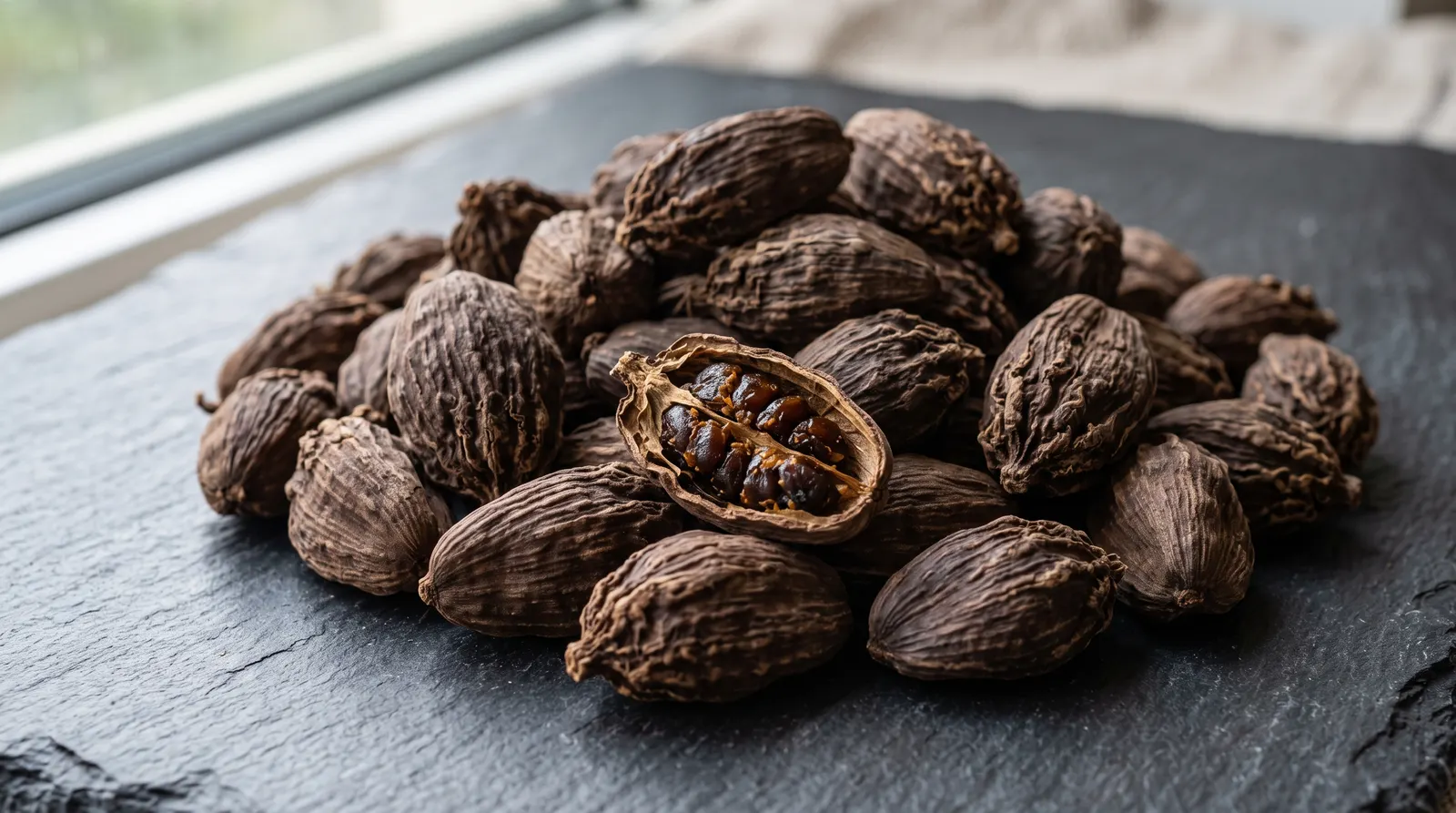
What Black Cardamom is
The smoke-dried, savory counterpart to green cardamom, large enough that one cracked pod flavors an entire biryani. It grows on Himalayan slopes in Nepal, Sikkim, Bhutan and Darjeeling rather than in the southern cardamom hills, and it is one of the few spices for which Nepal is a leading world producer — known there as sukmel and ground into the everyday meat masalas of Nepali kitchens. The smokiness is literal: the pods are traditionally cured over slow wood fires, and the smoke is in the spice, not an association. It sells alongside green cardamom at Indian grocers in Japan, usually cheaper by weight.
The dried fruit of Amomum subulatum, a large-leaved relative of green cardamom in the ginger family, harvested from plants grown between roughly 1,000 and 2,000 meters. After picking, the pods are dried — in the traditional method over wood fires in ventilated drying houses; faster commercial methods leave less smoke in the seed. The plants are typically grown in the shade of Himalayan alder trees, and Sikkim is the leading Indian producer. The pod runs two to three centimeters long, dark brown and ridged, with the same sticky brown seeds inside as its small green cousin. Harvest falls in autumn. The plants are slow to bear and are prone to viral diseases known locally as chirke and foorkey, which have cut yields in Sikkim and Darjeeling. Nepal grows the largest share of the world crop, concentrated in the eastern hill districts around Taplejung, where it is a significant cash crop for small farms. Chinese cooking uses a related but different species, Amomum tsao-ko, sometimes also sold as black cardamom; it is a separate spice and the two should not be swapped.
Taste profile
Smoky, resinous and camphor-cool, with a eucalyptus edge and none of green cardamom's sweetness. It belongs in savory, slow-cooked food only — a pod in a dessert would ruin the dessert. The smoke sits on top of a menthol-like coolness that survives long simmering, which is why it suits biryani rice and rich meat gravies cooked for hours. The pod is always cracked or split before it goes in, since a whole uncracked pod keeps its flavor to itself, and it is fished out before serving or left on the plate to be eaten around. Two pods are the ceiling for a large pot; beyond that the smoke takes the dish over. Choose plump pods with unbroken skins and a clear smoky smell, since split, dusty or odourless pods are old stock.
Forms to buy
- Whole pod — The standard form; crack it before adding, remove it before serving.
- Seeds only — Decorticated seeds sold loose, easier to dose into ground masala blends.
- Ground — Rarely sold ground; the smoke note fades fast once milled.
The science behind it
Black cardamom's flavor is dominated by 1,8-cineole, also called eucalyptol, which gives a cool, camphor-like, mint-and-resin note. Reported shares of cineole in Amomum subulatum oil range widely, from about 40 percent to roughly 80 percent in the studies cited, depending on cultivar, origin and sample, with oxygenated monoterpenes about half of the oil in one analysis and geraniol and alpha-terpineol as other notable components.
Laboratory studies show antimicrobial effects for black cardamom oil, strongest against fungi. A 2018 comparison of three cardamom species found that the black cardamom oil, from a single market sample, inhibited Candida strains and several bacteria in disc and dilution tests, and affected some virulence behaviors of Pseudomonas aeruginosa in vitro, though some of its enzyme results are reported inconsistently. A 2020 analysis of two imported fruit samples found markedly different cineole levels from the literature range, which shows how variable the oil is. Traditional uses in digestion and as an appetizer are recorded in Ayurvedic reference sources, but controlled human trials of black cardamom for any condition are lacking. Culinary amounts do not approach the doses used in laboratory work, and nothing here shows a treatment effect.
Sources: Chemical and Biological Evaluation of Essential Oils from Cardamom Species, Molecules (2018); Composition and pharmacological activity of essential oils from two imported Amomum subulatum fruit samples (2020)
This summarizes published research for general interest. Most studies use concentrated extracts at doses far above what a recipe contains, and none of it is medical advice — talk to a doctor before using any spice as a treatment.
In Vedic and ritual tradition
Black cardamom, Amomum subulatum, is known in Hindi as badi elaichi and in Sanskrit as brihat ela, large cardamom. An Ayurvedic college reference places it in the drug groups of several classical texts, listed with the texts below; these are classifications reported by a secondary source, not descriptions of the plant. Its everyday role is in the kitchen and in digestive formulas, and black cardamom has no documented role in puja or temple worship.
- Charaka Samhita — A Sanskrit-college plant reference lists the plant in Charaka's pain-relieving (shoolaprashamana) and appetizing (deepaniya) drug groups. This is a group classification reported by a secondary reference, not a description of the plant.
- Sushruta Samhita (Eladi gana) — The same reference places the plant in the Eladi gana of the Sushruta Samhita and the Eladi varga of Vagbhata's work. These are classifications reported by a secondary source, not passages describing the plant.
- Bhavaprakasha Nighantu (Dhanya varga) — A Bhavaprakasha verse gives the synonyms bahdela, tuvarika, sugandha and triputa, and the Bhavaprakasha places the plant in the Dhanya varga, a group of grains and spices.
Sources: Brihat ela (Amomum subulatum) and classical references, SDACH plant reference
Halal note
A plain dried pod with no halal concern in whole form. Pre-ground Nepali or garam masala blends containing it are milled products, worth a label check for additives exactly as with any ground spice blend.