Ajwain
Also known as: carom seed, bishop's weed
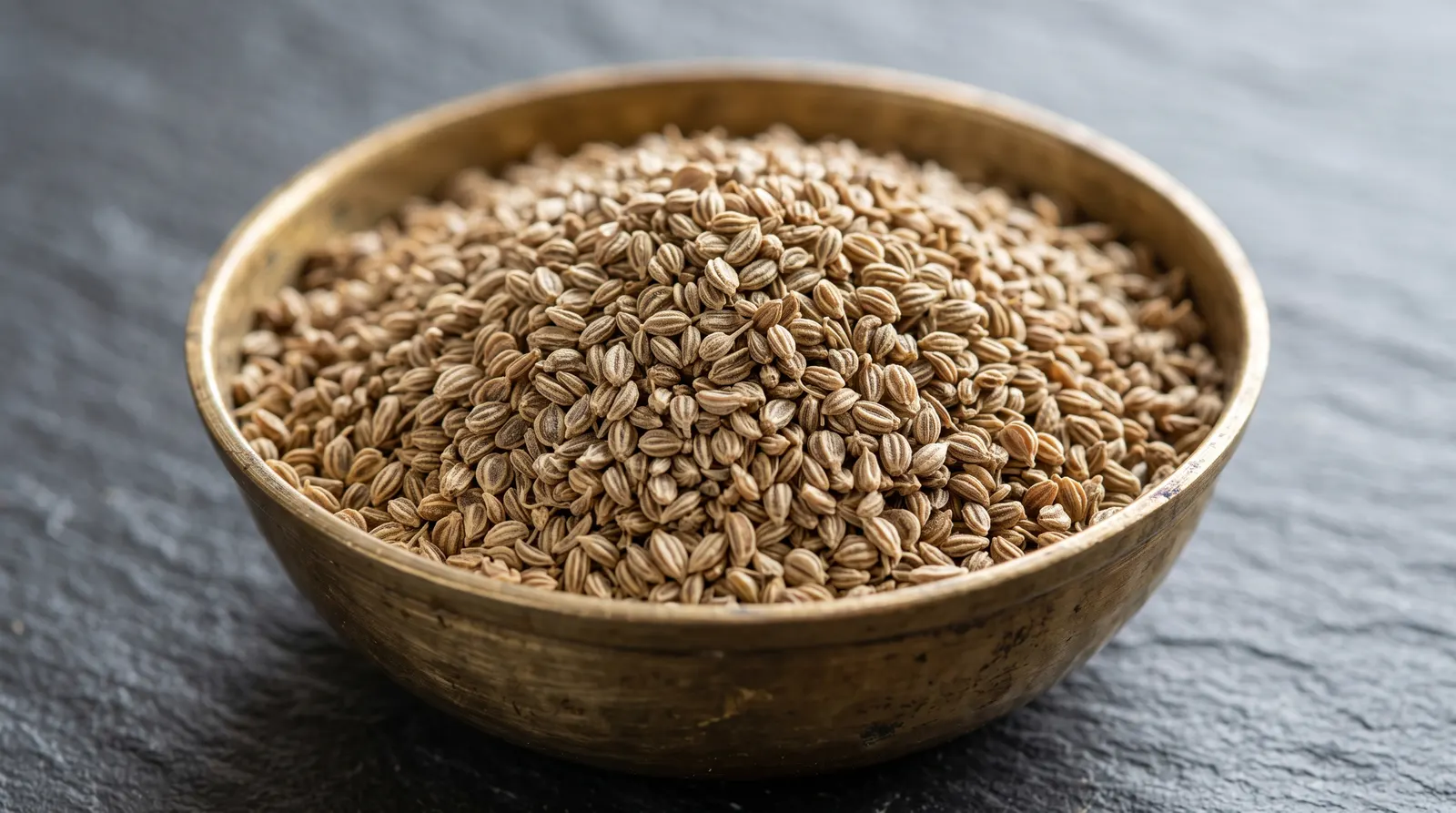
What Ajwain is
A tiny seed with a bite far beyond its size, kneaded into paratha dough and whisked into pakora batter across North India in quantities measured in pinches. Its reputation runs parallel to the kitchen: ajwain steeped in hot water is one of the most widely used Indian home remedies for indigestion and gas, and its presence in fried snack food is pointed — the seed is traditionally believed to help digest exactly the foods it is added to. In Japan it sits in most Indian grocers' seed shelf in small packets, and Tamil kitchens know it as omam, steeped as omam water for the same complaints. 'Bishop's weed' is an old herbal name that survives on English-language labels; carom is the other one.
The small, ridged, grey-brown fruit of Trachyspermum ammi, an annual in the carrot family grown mostly in the dry plains of Rajasthan and Gujarat, with smaller crops across Egypt, Iran and Afghanistan. It looks like a plumper, paler version of celery seed, but it tastes of thyme rather than celery. Ajwain leaf, sold under a similar name in some regions, comes from an unrelated plant, Plectranthus amboinicus, and is a different product. Outside India, ajwain is an ingredient in Ethiopian berbere, where it is known as netch azmud. Fresh seed is greenish-grey and smells sharply of thyme when rubbed, while dull, scentless seed is old stock. The crop is sown in autumn and cut in spring once the seed heads brown, then dried and threshed like any small umbellifer. What is sold as seed is the whole fruit, two tiny seeds joined by a pale ridge, and a teaspoon holds several hundred of them.
Taste profile
Sharp, hot and unmistakably thyme-like, with a medicinal edge that crosses into bitterness when overused — a quarter teaspoon seasons an entire dough, and more is worse, never better. The heat sits at the back of the throat rather than on the lips. Dry-toasting the seed, or giving it a few seconds in hot ghee, tames the sharpness into a rounder, savory version of itself, and many cooks roast it lightly before kneading it into dough precisely for that reason. In samosa pastry it goes into the dough rather than the filling, and it also seasons mathri, the savoury biscuits made for travel. Crushing the seed between the fingers releases the thymol at once, while a seed left whole gives it up slowly through the cooking, which suits a dough that will be rolled thin.
Forms to buy
- Whole seed — The only form most kitchens need; keeps its bite for a long time whole.
- Roasted and ground — For snack masalas and home remedies; loses strength faster once ground.
- Raw ground — Unroasted and milled, for blends that want the sharper raw bite; it stales within months.
The science behind it
Ajwain's character is mostly thymol, a phenolic compound with a thyme-like smell and a sharp, tingling bite. Thymol makes up most of the seed's essential oil in many samples, though reported shares range widely: about 60 to 96 percent across 14 Iranian populations in one study, and about 24 percent in the oil used in another. Smaller notes come from p-cymene and gamma-terpinene, which tend to be higher where thymol is lower. Thymol is a stable phenol, and the seed keeps its punch in fried batters and dough, which is why ajwain is kneaded into paratha dough and whisked into pakora batter.
Ajwain has a substantial laboratory literature. Thymol-rich oils and extracts show antibacterial, antioxidant and insecticidal activity in test tubes and in non-human studies, and one study found thymol the most toxic of the oil's main components to small hive beetles. Those concentrations are far above what a pinch of seed contributes to a dish. A 2014 review of the seed lists many traditional and experimental effects, including carminative and antimicrobial ones, but its authors state that comprehensive clinical trials are lacking and are needed to confirm them. The popular use of ajwain water for indigestion and gas is a traditional practice, and there is little controlled human evidence for it.
Sources: Thymol screening, phenolic contents, antioxidant and antibacterial activities of Iranian populations of Trachyspermum ammi, Scientific Reports (2022); Insecticidal Toxicities of Three Main Constituents Derived from Trachyspermum ammi Fruits against the Small Hive Beetle, Molecules (2020); An overview on Ajwain (Trachyspermum ammi) pharmacological effects; modern and traditional, Journal of Natural Remedies (2014)
This summarizes published research for general interest. Most studies use concentrated extracts at doses far above what a recipe contains, and none of it is medical advice — talk to a doctor before using any spice as a treatment.
In Vedic and ritual tradition
Ajwain is yavani in Sanskrit. The 13th-century Rajanighantu describes yavani as pungent, bitter and hot, relieving colic, bloating, worms and vomiting and stimulating digestion, and a Bhavaprakasha verse calls it digestive, palatable, sharp and light. These classifications place ajwain among the carminative seeds, which matches its present role in parathas and snack foods. The seed also appears in medieval Persian medical writing under the names zenyan and nankhah. The English names bishop's weed and carom are later labels. Ajwain has no significant role in Vedic ritual.
- Rajanighantu (13th century) — The 13th-century Rajanighantu describes yavani as pungent, bitter and hot, relieving piles of the vata type, colic, tympanites, worms and vomiting, and stimulating digestion.
- Bhavaprakasha Nighantu — A verse of this 16th-century lexicon describes yavani as digestive, palatable, sharp, fierce, pungent and light.
Halal note
A plain dried seed with no processing and no halal concern. Blended snack seasonings built around ajwain — biscuit and chaat masalas — are the only place to check a label for other ingredients.