Nepali Festival Foods
Also known as: dasain food, tihar food, sel roti
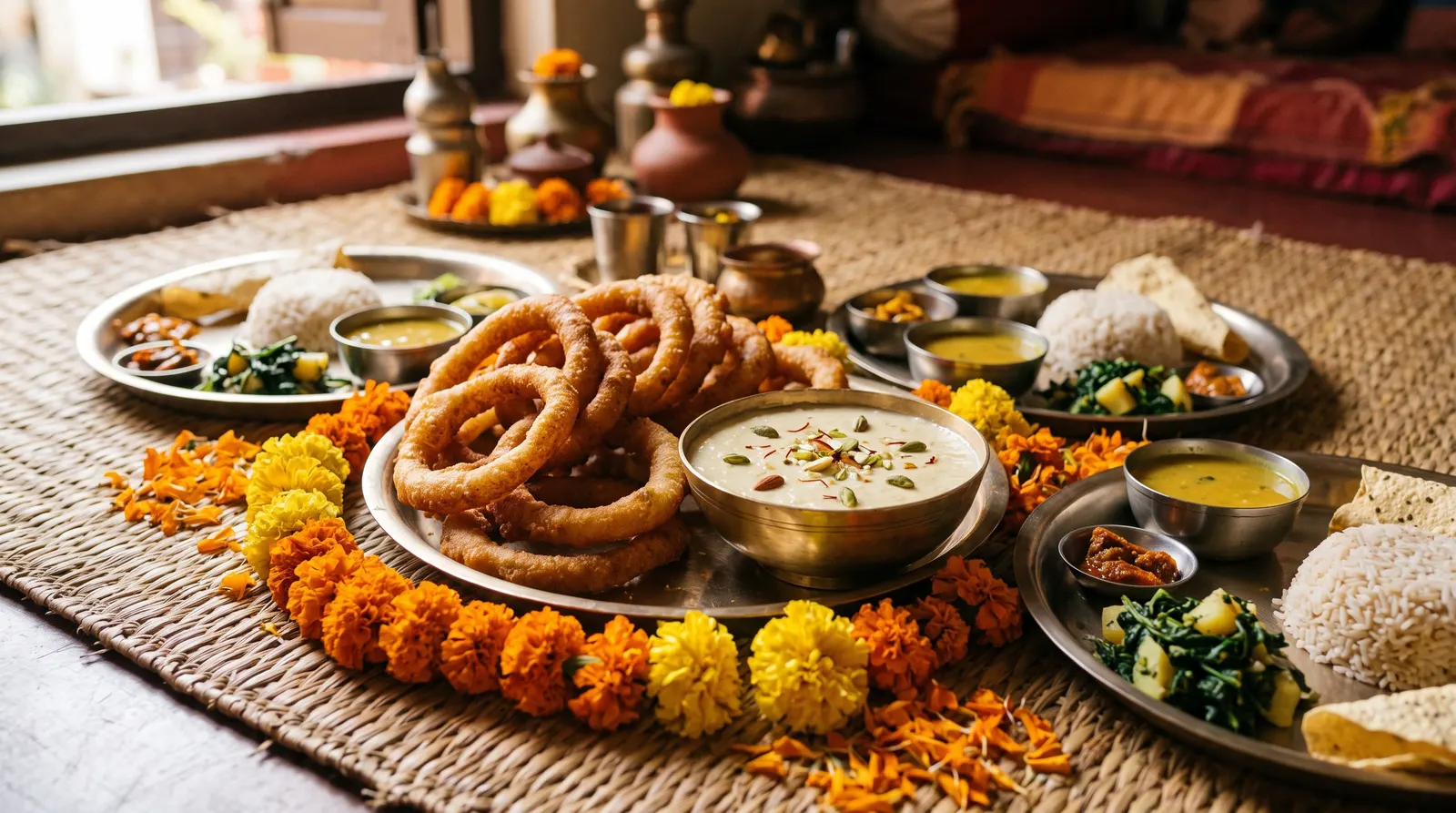
What Nepali Festival Foods is
Nepal's festival calendar sets its table. Dasain, the country's biggest festival, means goat curry over mountains of rice; Tihar, the festival of lights, means sel roti fried by the stack and children singing at the door for it. Between them, these two festivals define what festive food means in Nepal. The calendar is lunar, so the season is a better guide than any fixed date.
Where it comes from
Dasain falls in autumn, at the close of the nine-night Durga period, and families travel home for it the way others travel for a new year. The centered plate is masu-bhat: khasi ko masu, goat curry, over rice, with the meat traditionally sourced fresh for the season. Alongside comes sel roti, the ring-shaped bread of rice-flour batter sweetened with sugar and flavoured with ghee and cardamom, poured in rings into hot oil and fried until the outside crisps. Weeks later comes Tihar, five nights of lamps, and sel roti returns, this time with children going door to door singing bhailo and deusi songs. In the Kathmandu Valley, Newari families mark rituals with samay baji, a platter of beaten rice (chiura), roasted soybeans, boiled eggs, achar and a small pour of aila, home-distilled rice liquor. Tihar's five days each honour something different — crows, dogs, cows, the goddess of wealth, and brothers — and the food moves with them. Laxmi Puja brings kheer and sel roti and lamps on every windowsill; Bhai Tika closes the festival with a plate set for the brothers, a seven-colour tika and the best meal the household will cook that month. Dasain has its own arc: the first nine days are for the goddess, the tenth, Bijaya Dashami, is the day of tika from the elders, and the fortnight ends with Kojagrat Purnima, when the household stays up late and eats.
The food rules
- Sel roti — Fried in a ring from a thick batter. Because it keeps for several days it is made in bulk for both Dasain and Tihar and exchanged between households.
- Tihar: bhailo and deusi — Bhailo is traditionally sung by girls and deusi by boys, and the singers are given sel roti, sweets and money.
- Samay baji — Newar households serve it at weddings and other rites as well as festivals; the full version usually includes spiced meat such as choila, and vegetarian families leave it out.
- Tika and jamara — Rice, yogurt and vermilion on the forehead and barley shoots behind the ear — given by elders on Bijaya Dashami and eaten as much as worn.
What it means today
The calendar travels with the diaspora: Nepali restaurants in Japan fry sel roti during Dasain and Tihar and announce it weeks ahead, and goat curry appears on specials boards for Dasain the way turkey does elsewhere in autumn. A diner who knows the season knows what to look for. What a restaurant will not usually do is reproduce the festival itself. Tika, jamara and the family plate belong to the house, not the dining room, and the Nepali dishes a kitchen can sell in quantity are the everyday ones — momo, thukpa, dal bhat, sekuwa. Sel roti is the exception, because a Nepali customer will ask for it by name in the weeks around the festival. In Kathmandu itself the season is visible on the street rather than on the menu: sel roti sold from a ring of hot oil at a roadside stall, and goat hanging outside the butcher's shop in the days before Bijaya Dashami.
In a restaurant
If you are invited into a home at Dasain, expect tika and jamara from an elder, who may also give you a small gift or some money; accept it with both hands, or with the right hand supported at the wrist, and do not wipe it off while you are still in the house. The plates come next, and they are generous — masu-bhat, sel roti and often aila or raksi offered in a small glass. You can refuse the alcohol without ceremony; a hand over the glass is enough and no one will press. If you do not eat goat, say so before the food is plated rather than leaving it, and you will be given the vegetarian side of the same meal. Do not assume the festival is one day: a household may be quiet one week and full the next. In a restaurant, ask whether sel roti is being made, because it is seasonal rather than a menu fixture, and ask for masu-bhat rather than for a curry if you want the festival plate. At Tihar, if the bhailo singers come to a door you are standing in, the household gives them something; you are not expected to.
A common misunderstanding
Because momo is the Nepali dish that travelled, outsiders often assume it is the festival food, and that Nepali celebrations look like Indian ones with dumplings added. Momo is everyday food — the thing you buy at a stall, eat at a desk, order on a cold evening — and no household builds a festival around it. The festival plate is rice and goat, or rice and whatever the household can afford, with sel roti fried by the stack for visitors. The second assumption is that Dasain and Tihar are the same festival, or that either is simply the Nepali Diwali. Dasain is devoted to Durga; Tihar comes weeks later and shares only the lamps and the sweets with Diwali. The third is that the food is Indian food under another name. It shares a spice grammar, but the festival table is plainer than a restaurant curry: the meat is boiled and then fried rather than simmered in a tomato masala, and the heat comes from a pickle on the side rather than from the gravy.