Ayurveda and the Six Tastes
Also known as: shad rasa, six tastes ayurveda
What Ayurveda and the Six Tastes is
Ayurveda, India's classical system of medicine, sorts everything edible into six tastes — shad rasa: sweet, sour, salty, bitter, pungent and astringent — and holds that a meal carrying all six is complete. That idea, quietly, is the blueprint behind the Indian thali. The framework is old, text-based and applied loosely: it is a way of describing balance in a meal rather than a nutrition system with a menu.
Where it comes from
Set out in classical texts such as the Charaka Samhita, each taste is said to be built from the five elements — sweet from earth and water, bitter from air and space, and so on — and to act on the body's three doshas — vata, pitta and kapha — in its own direction. Broadly, sweet, sour and salty tastes are grounding and building, while bitter, pungent and astringent tastes are lightening and drying. Ayurvedic eating aims at a measure of each taste rather than favouring one. Meal order differs by region: a traditional Bengali meal opens with something bitter, such as shukto, and ends with sweets, while a Gujarati thali brings sweet and savoury together on one plate. The clearest single-dish example is Ugadi pachadi, eaten at the Telugu and Kannada new year: jaggery, neem flower, tamarind, raw mango, chilli and salt, one for each taste, and traditionally read as a picture of the year's mixed experiences. Two further terms matter for reading the system. Each taste carries a potency, heating or cooling, and a post-digestive effect, so the same taste can be prescribed in different directions for different people and different seasons. The texts also disagree with each other on detail, and living practice differs by region, so 'Ayurvedic' describes a family of approaches rather than one rulebook — which is worth remembering when a menu uses the word.
The food rules
- Madhura — sweet — Rice, dal, milk, ghee, ripe fruit — the nourishing base and the largest portion of the plate.
- Amla — sour — Lemon, tamarind, yogurt, pickle — wakes the appetite and digestion.
- Lavana — salty — Salt in its measure — kindles taste and the digestive fire.
- Tikta — bitter — Methi, bitter gourd, leafy greens — cooling and drying.
- Katu — pungent — Chilli, black pepper, ginger — heats and clears the palate.
- Kashaya — astringent — Lentils, turmeric, unripe banana — dries and firms.
What it means today
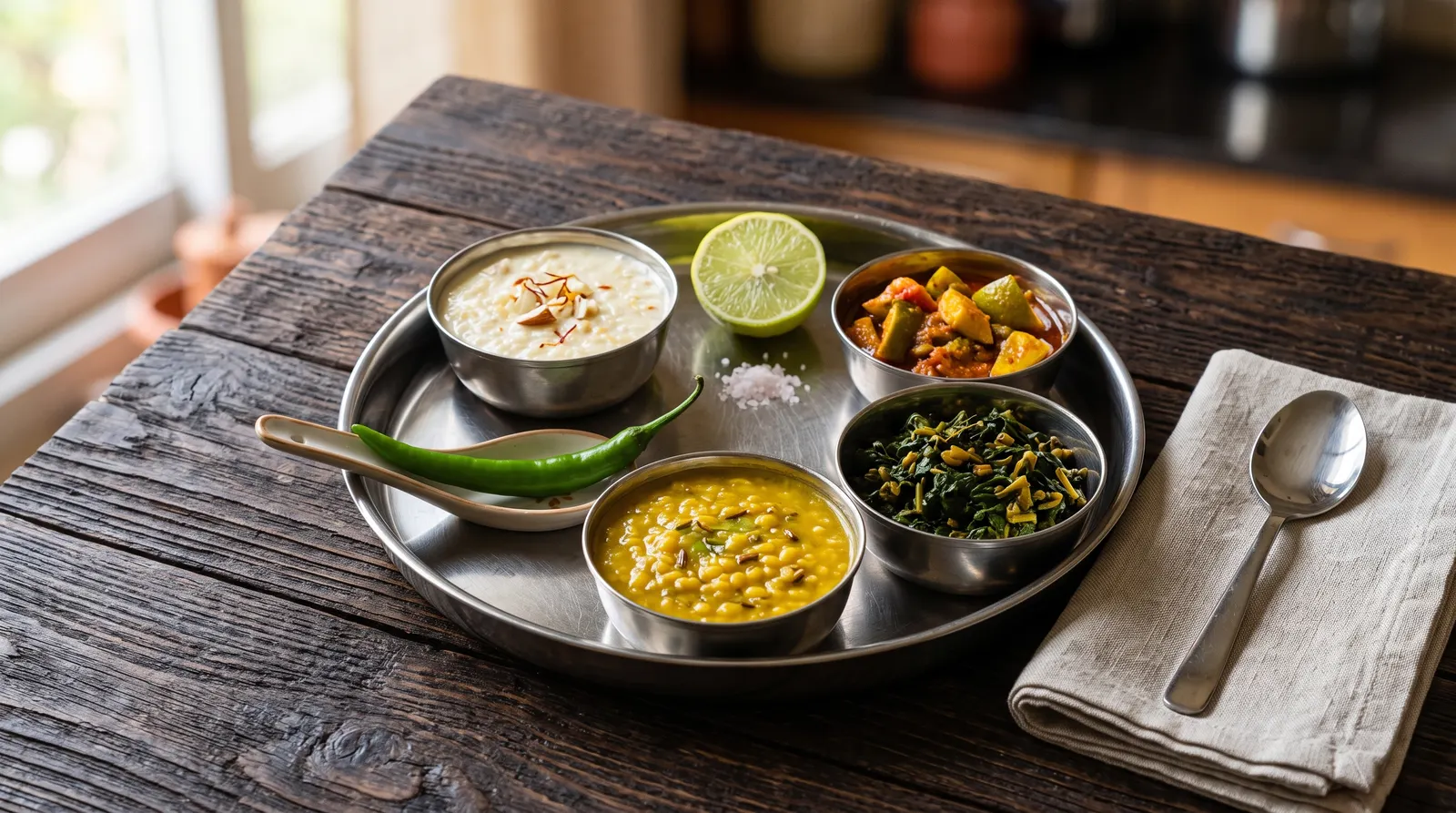
A diner can read the logic straight off a menu: a thali with dal and rice (sweet), pickle (sour and salty), methi or saag (bitter), chilli heat (pungent) and turmeric in everything (astringent) is the six-tastes framework served on a steel plate. It explains why Indian meals rarely arrive as a single dish — balance is the point. Restaurants borrow the language loosely. An 'Ayurvedic' menu abroad usually means mild, vegetarian and light on oil, which is a fair gloss on some of the tradition and a long way from a prescription. A thali is rarely labelled Ayurvedic even when it is built on the logic, and the clearest sign that the framework is at work is not a heading on the menu but the arrival of the pickle, the bitter green and the bowl of yogurt alongside everything else.
In a restaurant
For a diner, the framework is most useful as a way of ordering rather than as advice. Order across the tastes: a sour element (pickle, tamarind, lemon), a bitter one if the menu has it (methi, karela, a green), something salty and something sweet, and you have done what a thali does. Do not read the framework as medical guidance. An Ayurvedic restaurant is serving food, not treatment, and the classical texts work with a practitioner, a constitution and a season, none of which a menu knows. As a guest, eat what is put in front of you and do not announce that the meal is unbalanced because the bitter element is missing; the host did not ask for a consultation. If you are cooking for someone who follows an Ayurvedic regimen, ask what they avoid — the list is personal and seasonal, not a fixed set of banned ingredients — and do not assume the diet is vegetarian. Several classical texts discuss meat and meat broths among foods, and the strictly vegetarian reading comes more from yogic and devotional practice than from the medical texts.
A common misunderstanding
The commonest misunderstanding is that Ayurveda requires all six tastes at every meal and that a plate missing the bitter or the astringent note is somehow wrong. The six-taste idea is a framework for balance across a meal or a day, adjusted for constitution, season and digestion; the classical texts are at least as interested in quantity, timing and how the food was cooked as in the count of tastes on the plate. Many ordinary Indian meals carry three or four tastes and are not considered deficient. The second misunderstanding is that 'Ayurvedic' on a menu means something regulated. It does not, and it can appear on a dish no practitioner would recognise as part of a regimen. The third is the assumption that Ayurveda is a system of herbal supplements with a food section attached. In the classical texts food is the main subject and medicine is the intervention; the six tastes describe what eating well looks like, not a supplement programme to be bought.